Pages


Showing posts with label 4.5 Stars Book. Show all posts

Sunday, October 13, 2013

Book Review - My Road To Wealth: Learn About Obtaining Wealth Through The Story Of A Young Self Made Multimillionaire by Todd Babbitt

My Road To Wealth: Learn About Obtaining Wealth Through The Story Of A Young Self Made Multimillionaire


My Road To Wealth: Learn About Obtaining Wealth Through The Story Of A Young Self Made Multimillionaire by Todd Babbitt

I bought this book a while back, and never got around to reading it (though I must have started reading it at some point, as I'd taken notes on the earlier pages! But I had no memory of it...) When I was sorting out my books to see what books should go back onto the bookshelf, this book screamed "read me!" and so I did.

I wish I'd read this earlier! The author is about 5 years older than me and seemed to have accomplished much more! This was a very fast read - not a how-to book, but rather, just the author's story on what he did to become wealthy. He was very willing to share what he did - not to the minute details but enough to get you thinking. Now, while he was a bit lucky and was investing in real estate at the right time, he worked hard to get to where he was - he did not just sit there and money did not just appear out of nowhere. He researched, he learned, he took risk, and he acted. He also was clear that real estate was not the only way to wealth - it just happened to be something he was interested in.

He was an avid reader - and he included a list of some of the best books he read, so I appreciated that. In fact, I'd bought a couple of the books he recommended, and would prob buy the rest once I read some of my other books. He had a point there - for a small amount of money (for a book), you got to learn  so much from other successful people, isn't that a great investment?! Now again, none of these books are quick-get-me-rich books (those are called scams), but they'd be good guides to help us find our own path.

He said that many people kept wondering what they'd do if they have money, and yet never did anything much to act on getting rich. Yes, definitely guilty of that.

4.5 Stars.

Note - I bought this book


All reviews and posts are copyrighted by Christa @ Mental Foodie. Please do not use or reprint them without written permission.

Monday, March 11, 2013

Book Review - Until I Say Good-Bye: My Year of Living with Joy by Susan Spencer-Wendel, Bret Witter


Until I Say Good-Bye: My Year of Living with Joy by Susan Spencer-Wendel, Bret Witter

I don't think I'd teared up so much while reading a book. How could you not, when you read about Susan, who has ALS, deteriorates over time. You are touched by her strength, her courage, her positive attitude, and her love and joy for life; but yet, you can't help but feel sad for her and her husband and her 3 children. I know she wouldn't want us to feel sorry for her, so I won't.

I definitely appreciate this book more now that I have a child. And I can't imagine what I'd do if I was in her shoes.

In a way, this book reminded me of  The Last Lecture by Randy Pausch, Jeffrey Zaslow a bit that both Susan and Randy wrote their respective books as a gift for their children, because they know they won't be around when they grow up. And what a gift. It is also a love tribute to her husband, as you can read between the lines the love they have for each other.

An interesting tidbit - because of ALS, Susan who was a reporter, cannot type or write anymore. So she pretty much wrote her whole book using an iPhone with one thumb that she still has control of. She couldn't even use an iPad because the keyboard is too widely spaced for her to move her thumb. Can you imagine.

Go read this one. I have dog-eared so many pages that I would have to read those passages when I feel down in the future. Then I'll remember how lucky I have it. Sometimes we need a kick in the butt like that.

4.5 Stars.

Note - The ARC was given from HarperCollins free in exchange for an unbiased review


All reviews and posts are copyrighted by Christa @ Mental Foodie. Please do not use or reprint them without written permission.

Thursday, November 17, 2011

Book Review - The Human Bobby: A Novel by Gabe Rotter


Title: The Human Bobby: A Novel
Author: Gabe Rotter
Year: 2010
Page: 320
Genre: Fiction - Literary

FTC Disclosure: Borrowed from the library

Summary (from goodreads.com):
A page-turning story of the unraveling of one man's seemingly perfect life, and his struggle to get it back.

First Sentence:
There's a staccato clicking sound in my head.

My Thoughts:

  • I have not seen a lot of reviews of this book, but from the few reviews, they all said the same thing - read it! I don't think I had seen a negative review. BermudaOnion's review was one of the first reviews I'd read, see here.
  • Seriously, if I saw this book in the library or book store, I would have NEVER picked it up. Not even to read the back description to see what it was about. Not based on the title. Not based on the cover. Really, if it wasn't for the other bloggers, I would have missed out on this brilliant book. This is such a shame that this book hadn't been given more attention when it came out last year. I had been meaning to read it for a while, but my library did not have it, and I finally found it from an inter-library in the network. After reading the book, the title made sense, but it's definitely not an eye-catching title. And the cover is related to the story (the yellow tent has its significance), but again, not eye catching. It looks gloomy. The cover reminded me of another literary fiction I didn't quite like - Caribou Island (see my review here with a cover picture.) I hadn't given it much thought about what the title should be, or what the cover should look like, but it is just unfortunate that this book might not have gotten a lot of attention based on this first exterior impression.
  • But yeah, I am going to echo all the other bloggers - READ IT! This will be one of my top 5 reads of 2011. I know, we still have 1.5 months to go, but I doubt it'd fall outside the top 5. It was a  fast paced page turner, and I finished in 2 days. Would have finished it in one setting if I didn't have to go to work.
  • The book actually started on Chapter 31, which is rather unusual. I suppose it's like a prologue, but unlike the typical prologue, it didn't give up the ending, but rather connect the dot when you were about 2/3 through the story. It's almost a word-for-word repeat of Chapter 31, rather than just a hint of what was to come. I had to say though, after reading the book, this made sense, but when I first read it, it was a little confusing and this chapter was a little boring. So I was glad I didn't decide to drop the book based on this chapter alone (luckily it wasn't a very long chapter). After this chapter though, the rest was very easy to follow!
  • I don't quite know how to categorize this book - is it a literary fiction (since it said A Novel?) but it is so fast paced that it almost read like a thriller or suspense - after all, the protagonist's son went missing, and his life went from perfect to hell. And the plot twist was just brilliant - I thought I had it figured out, like who the kidnapper was, and I was right about that, but then I was also so wrong! I couldn't really tell you about it, or it'd spoil the fun. I couldn't really tell you which character I liked or disliked, because that'd give away too much! Seriously, this is definitely a book that the lesser you know, the better. 
  • The tone of this book reminded me of This is Where I Leave You by Jonathan Tropper (read before blogging) or Domestic Violets by Matthew Norman (see my review here). But this one was better due to the plot, plus I just liked the characters better too. I liked its subtle humor (see quote below.) So if you like these two books, you'll probably like this. Even if you have never read these two books, you should still read this! I liked that this was written as a 1st person perspective, as you'd really get to know Bobby the protagonist.
  • I could see this book being made into a movie - how who should play Bobby? For some reason I can see Tobey Maguire or Jake Gyllenhaal. 
  • I'd definitely read more of this author's work.  This book was refreshing, and it had been a while since a fiction book excited me (I read this before Children of Paranoia, and that's another one I'd highly recommend, see my review here), that I can't wait to recommend to other people! Some people said they didn't quite like the ending, but to me, the ending was what makes this story so good. The reason it's not a 5 Stars is that I didn't get overly emotional. That speaks volume actually, for me to give a high rating to a book that doesn't make me cry!

Quote: 
Shit, meet fan. (p114)

Overall Rating:


4.5 Stars. Read it, and enjoy the ride.


All reviews and posts are copyrighted by Christa @ Mental Foodie. Please do not use or reprint them without written permission.

Sunday, November 13, 2011

Book Review - Life, on the Line: A Chef's Story of Chasing Greatness, Facing Death, and Redefining the Way We Eat by Grant Achatz, Nick Kokonas


Title: Life, on the Line: A Chef's Story of Chasing Greatness, Facing Death, and Redefining the Way We Eat
Author: Grant Achatz, Nick Kokonas
Year: 2011
Page: 320
Genre: Non-Fiction - Memoir

FTC Disclosure: Borrowed from the library

Summary (from goodreads.com):
"One of America's great chefs" (Vogue) shares how his drive to cook immaculate food won him international renown-and fueled his miraculous triumph over tongue cancer.

In 2007, chef Grant Achatz seemingly had it made. He had been named one of the best new chefs in America by Food & Wine in 2002, received the James Beard Foundation Rising Star Chef of the Year Award in 2003, and in 2005 he and Nick Kokonas opened the conceptually radical restaurant Alinea, which was named Best Restaurant in America by Gourmet magazine. Then, positioned firmly in the world's culinary spotlight, Achatz was diagnosed with stage IV squamous cell carcinoma-tongue cancer.

The prognosis was grim, and doctors agreed the only course of action was to remove the cancerous tissue, which included his entire tongue. Desperate to preserve his quality of life, Grant undertook an alternative treatment of aggressive chemotherapy and radiation. But the choice came at a cost. Skin peeled from the inside of Grant's mouth and throat, he rapidly lost weight, and most alarmingly, he lost his sense of taste. Tapping into the discipline, passion, and focus of being a chef, Grant rarely missed a day of work. He trained his chefs to mimic his palate and learned how to cook with his other senses. As Kokonas was able to attest: The food was never better. Five months later, Grant was declared cancer-free, and just a few months following, he received the James Beard Foundation Outstanding Chef in America Award.

Life, on the Line tells the story of a culinary trailblazer's love affair with cooking, but it is also a book about survival, about nurturing creativity, and about profound friendship. Already much- anticipated by followers of progressive cuisine, Grant and Nick's gripping narrative is filled with stories from the world's most renowned kitchens-The French Laundry, Charlie Trotter's, el Bulli- and sure to expand the audience that made Alinea the number-one selling restaurant cookbook in America last year.


First Sentence: 
On June 8, 2008, I flew to New York to attend the James Beard Foundation Awards.


My Thoughts:

  •  I love food, I love reading how chefs become chefs. I guess I never thought about food being both an art and a science before, but once I learn more about it, food is like magic. I have heard of the restaurant Alinea before (you can read a brief description on wiki here or go to the restaurant's website). I think I first heard about it because I was browsing different cooking blog, and stumbled upon this one - Alinea At Home - which is quite impressive because of the ingredients and technique used in these dishes. I didn't know a lot about Alinea apart from browsing their website, read a few reviews and saw a few pictures. When I saw this book on my library's new catalog, I was intrigued - especially, "Facing Death"? What do they mean?
  • I really enjoyed this memoir - it was a bit of a memoir, a bit on the chef's creativity, and a bit on their restaurant business history and model. The chef, Grant Achatz, wrote the majority of the book, and this business partner, Nick Kokonas wrote part of it relating to the business and a bit about his own personal journey. Some people wondered why Nick was included, as they just wanted to learn more about food and Grant as a chef. But i like to hear Nick's perspective too, because really, without Nick, there is no Alinea. Or quite possibly it'd be a different restaurant altogether. I doubt it'd be the same because Nick let Grant had his vision, and Nick just made it happen.Another business partner might not have let that happen. Or Grant may not have enough financing to open his restaurant until a later date.
  • I think both authors were honest in their stories - the ups and downs they went through. I liked that Grant was grateful with the previous chef / mentor he worked with - Thomas Keller. I wish we all get to have a mentor like him. I admired people who teach and share their knowledge selflessly. He was also appreciate of another restaurant owner he worked with - Henry Adaniya at Trio, who did not restrict Grant's creativity. E.g. I never would have imagine a dish like this - it is a fish dish, but it is served in a bowl within a bowl. They'd place some flowers in the outer bowl, and the fish in the inner bowl. Once it's served, they'd add hot water to the bowl the flowers is in to release the scent of the flowers. He created this because it reminded him of the time when they'd eat walleye fish at a picnic with his family, where they could smell the flowers while they ate. Could you imagine - combing the visual, smell, taste, and texture all together? And most of all, it brought back his fond memories with his family.
  • After reading this book, it made me want to try Alinea in the near future, or at least sometime before I die (assuming I won't die too soon!) It is quite pricey for its tasting menu, which sometimes last for hours, but I am sure it'd be an experience - and that was what Grant envisioned. A new eating experience. It also made me want to borrow his cookbook though I know his technique is way beyond my skill level. I also want to eat at The French Laundry (Grant's mentor, Thomas Keller's restaurant in Napa), and Charlie Trotter's in Chicago even though Charlie wasn't the same mentor like Keller (Grant worked in his restaurant before going to Keller's, and let's just say it wasn't as positive of an experience.)
  • I just really loved reading about people's passion, dreams and their success stories (well the difficulties and failures too - so we could all learn from them). Interestingly, some of their "best practice" is also what we do at work in the health clinic - e.g. on their restaurant opening date, they limited the number of reservations/tables they'd serve, even if it meant they would not be making as much money, just so they could work out the kinks. We do the same when we open a new clinic or move to a new location, so that if something did not work, we did not impact the patients too much.
  • I teared up when I read the part where Grant went through his medical journey (I had no previous knowledge about it) and that was where part of the subtitle, Facing Death, came in. 
  • I wish though that Grant would have elaborated more on his thought processes on creating his dishes. He talked about some (see the flower/fish example above) but I just wished he'd talk a little bit more. But I supposed this might be intellectual property. I did find this video online that talked about "bouncing flavors" - about how he thought of pairing two (or more) unusual flavors together.
  •  I also wish the book would include more pictures of the food, and the serviceware designed especially for the food (not just for looks, but for functional reasons). It had some, but mostly in black and white. So I had to go  google for some more photos - you can see the design of the servicewear by Marin Kastner here - very fascinating. You can also find pictures of the food they served when the first opened here - a visual feast in itself. You can see more pictures of the "food lab" (where they are trying out different ideas) here.
  • I also learned something new - Alinea is the only Michelin 3-Star restaurant that doesn’t have tablecloths on their black wooden tables, which presented the unexpected problem of table condensation (when serving water).  Therefore, the staff calibrates the water to a specific temperature to avoid unsightly water. See the little details they thought of?
  • They had since opened a new restaurant called Next - the concept is very differently and recently they decided to devote it to childhood favorites - this is a fun video to watch (darn, I just found that the video had been removed due to some music copyright issue - but you can read about it here on Michael Ruhlman's blog. I have read a couple of Michael's books - though not his books on chefs/food, but do check them out as he is listed on my "read more" authors. I had read Walk on Water: The Miracle of Saving Children's Lives and House: A Memoir. I read these books before I knew he specialized in writing food! The first one was about pediatricians and the second one was about the fun and tears of renovating his historical house. Both were great reads.)
  • I also found a great article about this book here.  I didn't know that this book was rejected by 5 publisher first because it didn't fit into the traditional 1st person memoir. I am glad that the 6th one accepted it because this is going to be one of my favorite reads in 2011.
  • Wow, did I write a long post or what! If it is not clear already - read this book especially if you are into food! It definitely make me appreciate eating at restaurants even more - all the hard work the chefs and the team put into putting something together for us to enjoy.


Quote: 
Chef Keller always talked about thinking "big picture." He drilled that into all of the cooks at The French Laundry. With the tripe, he knew that if he showed us the right way to prepare it, he would be passing down not just a recipe but also a philosophy of cooking. (p77)

"I want to create an experience that is based on emotions. I want people to be excited, happy, curious, surprised, intrigued, and even bewildered during the meal." (p137)

Overall Rating:


4.5 Stars. I am hungry after reading this. But I am also inspired.


All reviews and posts are copyrighted by Christa @ Mental Foodie. Please do not use or reprint them without written permission.

Saturday, October 15, 2011

Book Review - Children of Paranoia (Children of Paranoia, #1) by Trevor Shane


Title: Children of Paranoia (Children of Paranoia, #1)
Author: Trevor Shanex 
Year: 2011
Page: 384
Genre: Fiction - Dystopian

FTC Disclosure: Received a free copy as part of the Crazy Book Tour, in exchange for an unbiased review.

Summary:

all wars have rules

rule #1: no killing innocent bystanders

rule #2: no killing anyone under the age of eighteen

break the rules, become the target


Since the age of eighteen, Joseph has been assassinating people on behalf of a cause that he believes in but doesn’t fully understand. The War is ageless, hidden in the shadows, governed by a rigid set of rules, and fought by two distinct sides — one good, one evil. The only unknown is which side is which. Soldiers in the War hide in plain sight, their deeds disguised as accidents or random acts of violence amidst an unsuspecting population ignorant of the brutality that is always inches away.

Killing people is the only life Joseph has ever known, and he’s one of the best at it. But when a job goes wrong and he’s sent away to complete a punishingly dangerous assignment, Joseph meets a girl named Maria, and for the first time in his life his singleminded, bloody purpose fades away.

Before Maria, Joseph’s only responsibility was dealing death to the anonymous targets fingered by his superiors. Now he must run from the people who have fought by his side to save what he loves most in this world. As Children of Paranoia reaches its heart-in-throat climax, Joseph will learn that only one rule remains immutable: the only thing more dangerous than fighting the war. . .is leaving it. 

First Sentence: 
Christopher, you need to know who you are.

My Thoughts:
  • I knew I had to sign up for this blog tour when I read this on Crazy Book Tours, "CHILDREN OF PARANOIA is set in a dystopian landscape reminiscent of I am Number Four and The Hunger Games, with a moral sensibility that will entice fans of Showtime’s Dexter. Trevor Shane effortlessly transitions between nail-biting action and heartfelt emotion, sure to delight genre fans and literary fiction lovers alike." I really liked the Hunger Games, I like dystopia, I like the concept of Dexter (I watched the 1st episode only and it was a little slow for me... but people had told me start from Season 2 instead? Anyway I digress.) so it is no surprise that this book sounds like my type of book!
  • Because of the Hunger Games connection, I was expecting a YA Dystopian for some reasons even though no where did the description said it was YA (in fact, it specifically said "since the age of eighteen, Joseph...") So I was pleasantly surprised that it was not YA. Now, there is nothing wrong with YA, but at my age (close to mid 30's) I'd become a bit picky when it came to YA since sometimes I feel I am too old for the "lessons learned". Not that I don't see the value in those lessons, but I'd learned them way too long ago already :) I was also a bit afraid that this would be character-driven and slower paced than the usual suspense/thriller because it said "A Novel" after the book title (as opposed to A Thriller). But I needed not worried, this book had BOTH great characters and action!
  • I am also not sure if this book really is dystopian. As I was reading it, I think the storyline could be happening RIGHT NOW. In fact, if you think more about it, it IS happening to a lessen degree - people hating (or maybe killing) each other for reasons no more than "we are the good guys, they are the bad guys". I guess there is no time limit when it comes to Good Vs. Evil.
  • The story was written as a diary but it wasn't really in a traditional diary format (i.e, not "Sunday, 1/2/11... Tuesday 3/2/11"). It was written in both 1st person and 2nd person "you" format, and this is not a style we typically see. Some paragraphs and chapters were quite long (especially compared to the usual thrillers when each chapter is typically quite short), but the story did not feel like it dragged on. In other books, long paragraphs sometimes annoyed me (just difficult to read) but this book didn't bother me.
  • I enjoyed the character development - I felt like I got to know Joseph and Maria and Joseph's friends quite well. They felt real. I particularly liked reading how Joseph taught the class to deliver maximum impact, and I enjoyed reading the details of his plan for each job.
  • It was not an ending I expected but it was fitting, and I can't wait to read Book 2 to find out where the story leads us.
  • There are a few other points I want to discuss but they include spoilers. So spoilers start now! 
  • [SPOILERS] -  Despite how much I enjoyed the book, I thought there were a couple of points that seemed a little unrealistic. 1st - no gun training? I would have thought it would be essential for an assassin. Secondly, what Joesph's mother did seemed a bit out of character? We'd only been hearing how sweet and loving his mother was, so I couldn't quite understand her action in betraying her son... it perhaps could have been elaborated more. But I supposed since this was written as Joseph's diary, we couldn't get the mother's thought process. Also, it made me wonder about the significance of the names - Joseph, Maria and Christopher? Or maybe I am reading too much into it. [/SPOILER]
  •  I loved the title of the book - very intriguing and yet very fitting to the story. While the cover did not give away much, the yellow definitely made it stand out.
  • Even though there is another 2.5 months left in 2011, I am fairly certain this will become one of my top 10 of the year. I loved that it had both good characters and plot. I was engrossed in the story to see where it'd go. I also got a bit teary eyed towards to end because I wish things did not turn out they way they did, but yet could understand why it happened the way it did. I read this just a couple of weeks ago, so I could still remember the story fairly well. It would be interesting to test its staying power when the next one comes out next fall (tentatively titled Children of the Underground.) Kudos to the author as this is his first novel!
  • Knowing what I know now, Children of Paranoia is more of a love story in disguise. Doesn't matter if it's dystopian or YA or not.

Quote:
"Okay, I know you guys are nervous. You're nervous for two reasons. First, you're nervous because you don't know why you're here. Second, you've got an idea abut why you're here and you're nervous that you might be right." (p23)

I guess the when is the question that's usually asked because when somebody punches you in the nose your first instinct isn't to ask why, it's to feel pain and anger and to want to punch back. Eventually, you'll ask yourself why. The why always comes. It's unavoidable. (p28)

When you've got passion, you don't need reason. It's only when you get old, like us, that you start asking questions. The older you get, the more your passion drains out of you and the more you look for a reason behind everything. (p55)

"Either they're evil or we are. And I know for damn sure that I'm not evil." (p153)


Overall Rating:


4.5 Stars. I can't wait to read Book 2 of this trilogy!


Tour Schedule:

10/11 - Kritters Ramblings   http://www.krittersramblings.com                       
10/12 - Ravishing Reads   http://ravishingreads.blogspot.com                        
10/13 - My Utopia   http://myutopia36.blogspot.com/                           
10/14 - Reader Girls   
http://readergirls.blogspot.com                          
10/16 - Mental Foodie   
http://mentalfoodie.blogspot.com                             
10/17 - Rants~N~Scribbles   
http://rantsnscribbles.blogspot.com       
10/18 - Sinnful Books   http://sinnfulbooks.blogspot.com                         
10/19 - A Bookish Affair   
http://abookishaffair.blogspot.com/                           
10/20 - Between the Covers   
http://www.betweenthecoversblog.net/               
10/21 - The Fiction Enthusiast   http://thefictionenthusiast.blogspot.com/      
10/22 - Proud Book Nerd   http://proudbooknerd.com/                           
10/23 - Book Hooked   
http://www.bookhookedblog.com                           
10/24 - Girls in the Stacks   
http://www.girlsinthestacks.com                          
10/25 - All I Ever Read   http://books.nicoleabouttown.com 


Trailer:


All reviews and posts are copyrighted by Christa @ Mental Foodie. Please do not use or reprint them without written permission.

Sunday, February 20, 2011

Book Review - Little Princes: One Man's Promise to Bring Home the Lost Children of Nepal by Conor Grennan


Title: Little Princes: One Man's Promise to Bring Home the Lost Children of Nepal 
Author: Conor Grennan
Year: 2011
Page: 304
Genre: Non-Fiction - Memoir

FTC Disclosure: Borrowed from the library

Summary (from goodreads.com):
One Person Can Make a Difference


In search of adventure, twenty-nine-year-old Conor Grennan traded his day job for a year-long trip around the globe, a journey that began with a three-month stint volunteering at the Little Princes Children’s Home, an orphanage in war-torn Nepal.

Conor was initially reluctant to volunteer, unsure whether he had the proper skill, or enough passion, to get involved in a developing country in the middle of a civil war. But he was soon overcome by the herd of rambunctious, resilient children who would challenge and reward him in a way that he had never imagined. When Conor learned the unthinkable truth about their situation, he was stunned: The children were not orphans at all. Child traffickers were promising families in remote villages to protect their children from the civil war—for a huge fee—by taking them to safety. They would then abandon the children far from home, in the chaos of Nepal’s capital, Kathmandu.

For Conor, what began as a footloose adventure becomes a commitment to reunite the children he had grown to love with their families, but this would be no small task. He would risk his life on a journey through the legendary mountains of Nepal, facing the dangers of a bloody civil war and a debilitating injury. Waiting for Conor back in Kathmandu, and hopeful he would make it out before being trapped in by snow, was the woman who would eventually become his wife and share his life’s work.

Little Princes is a true story of families and children, and what one person is capable of when faced with seemingly insurmountable odds. At turns tragic, joyful, and hilarious, Little Princes is a testament to the power of faith and the ability of love to carry us beyond our wildest expectations. 


First Sentence:
It was well after nightfall when I realized we had gone the wrong way. 

My Thoughts:

Why this book?
  • I first read about this on Bookworm's Dinner (see review). This is probably one of my favorite type of memoir to read (inspirational), so despite having many books piling up already, I reserved this straight away from the library. 
First thought:
  • Read it! Definitely will be in my Top 10 in 2011! And one I'd be recommending to others!
Cover Art:
  • LOVE it. The kid, the colors... 
Title:
  • Fitting. When I first heard it, I thought of The Little Prince by Antoine de Saint-Exupéry (one of my favorite books, and one that I'd re-read!), and wouldn't you know it that there is a connection.
Writing:
  • Very easy and engaging to read. The content of this book reminded me of Three Cups of Tea: One Man's Mission to Promote Peace... One School at a Time by Greg Mortenson and David Oliver Relin and Stones into Schools: Promoting Peace with Education in Afghanistan and Pakistan by Greg Mortenson and Khaled Hosseini. I'd say that this book is easier to read than Mortenson's books as the latter sometimes were a bit slow.
  • It was very hard to put down - even though it is non-fiction which typically scares people off, this will be a good "introduction" to non-fiction because it's not tedious. It talked a little bit of Nepalese history and explained why there were so many orphans, but it was written in an easy-to-understand and non-boring manner, that someone like me who usually isn't really into history understood it. 
Plot:
  • Well paced. Definitely made me want to know what happened next!
  • The author talked a little bit about his personal life, but it is related to his story of the Nepalese children so it just added on to the story
Characters:
  • Even though it is a memoir, the stars in the book really were the children. You just want to meet and help them when you read about them
  • The children could do so much with so little! (see first quote below)
  • Of course all the volunteers and local people who helped these children were remarkable also. I couldn't imagine walking for hours and hours and hours while wearing heavy packs, while the tracks (or lack of) were dangerous at times (right by the cliff!) and that it wasn't very safe (security wise) due to the civil war and its aftermath
  • The author was very honest and you could tell he life had been changed forever by these children  
  • My favorite child was probably Jagrit - the author described him so well that you could just hear him. He was mature and wise beyond his years
Ending:
  • Hopeful!
  • I wish there were more pictures, especially pictures of each children
  • Would be nice if there is some follow up on what the children are up to now.
Emotion:
  • Got teary at certain parts. You wondered if the parents did the right thing, and not being a parent, I couldn't tell especially since I don't live in their environment. You could say though that no matter where you live, parents (generally speaking) just want the best for their children, giving them what the parents couldn't have 
What I Learned:
  • I didn't know a lot about children trafficking in Nepal, so this book opened my eyes to that far corner of the world
PS:
  • If you do not want spoilers, DO NOT look at the photos in the book until after you have read the story!
  • Did I say, READ IT? :) 
Read this Author again?
  • Yes!

Quote: 
Though they would never admit it, the kids had far more fun with the toys they made themselves. one boy, usually Santosh, would take a plastic bottle from the trash discarded throughout the village. To this bottle he strapped two short pieces of wood, binding them with some old string. He collected four plastic bottle caps and some rusty nails and pounded them into the wood with a flat rock. And viola! he had built a toy car. When it wobbled too much going down the hill, he discovered that he could stabilize it by filling the bottle with water. Soon it was racing down shallow hills and crashing into trees. Because he had constructed it, he was able to fix it. (p38)

The kids spoke little English, but as I had learned long ago, language isn't always necessary when interacting with kids. (p229)

Overall Rating:
4.5 Stars. READ IT! (Didn't get 5 Stars only because I probably won't re-read. I hardly ever re-read) 


All reviews and posts are copyrighted by Christa @ Mental Foodie. Please do not use or reprint them without written permission.

Sunday, September 26, 2010

Book Review - Unwind by Neal Shusterman


Title: Unwind 
Author: Neal Shusterman
Year: 2009
Page: 335
Genre: Fiction - Young Adult, Dystopian

New to me author? Yes
Read this author again? YES!
Tearjerker? No
Where did it take place? US
FTC Disclosure: Borrowed from the library

Summary (from goodreads.com):
In a society where unwanted teens are salvaged for their body parts, three runaways fight the system that would "unwind" them.

Connor's parents want to be rid of him because he's a troublemaker. Risa has no parents and is being unwound to cut orphanage costs. Lev's unwinding has been planned since his birth, as part of his family's strict religion. Brought together by chance, and kept together by desperation, these three unlikely companions make a harrowing cross-country journey, knowing their lives hang in the balance. If they can survive until their eighteenth birthday, they can't be harmed -- but when every piece of them, from their hands to their hearts, are wanted by a world gone mad, eighteen seems far, far away.

In Unwind, Boston Globe/Horn Book Award winner Neal Shusterman challenges readers' ideas about life -- not just where life begins, and where it ends, but what it truly means to be alive.


First Sentence:
"There are places you can go," Ariana tells him, "and a guy as smart as you has a decent chance of surviving to eighteen."
  
Why did I pick this book?
I heard about this book from Reading On a Rainy Day's Friday Find. Even though I'd been trying NOT to add more books to my TBR list, for some reasons I just felt like I needed to read this NOW. I must've gotten the dystopian bug!

My thoughts:
  • WOW. I am so glad I read this! If you are into dystopian - read this next!
  • While, I still like the Hunger Games series better (okay, I just started reading Mockingjay today...), probably because Suzanne Collins' writing is a bit more engaging and less choppy, this book has one of the most intriguing concept! It takes "Safe Haven Law" to a new extreme... and yet, you can't help but think that it is realistic... 
  • "Tithing", the Storking Initiative, "Unwinding" 13-17 years old... all for the common good... was very interesting - it got my brain spinning. Now, I am not saying I am supportive of these rules, but it definitely made you think what if... [POTENTIAL SPOILER] if you're a parent, would you unwind your child, is unwinding still living or dying, is it better to sacrifice someone for the better goods of multiple people? Do orphans deserve to be unwinded just because no one loves them? Do you still have a soul if you're unwinded? Would you give up your baby for storking? What if you were forced to adopt? And the power of rumor... can start a riot! [/spoiler ended]
  • I like the names of the characters ("names" is one of my personal interests) - Dalton, Cyrus, Finch, Emby, Blaine, Lev, Jedediah, Risa, Josias, Roland, CyFi, Cy/Ty
     
  • I like Connor and Risa and CyFi. Lev - I don't know how I feel about him but I can see how he turns out to be the way he is. I thought CyFi would have a bigger role - but he was definitely a memorable character and my favorite
  • Part of the concept is similar to The Unit by Ninni Holmqvist but yet the two books are so different. Perhaps one deal with children, and one with older adults?
  • I think the reason why I like dystopian, is so I can tap into the author's creativity, things I could never imagine it myself and wish I could. Yes they can sometimes be depressing but the threat that it could become a reality, and that these are all very realistic scenario... made me glad that I can't live forever :) I guess I am typically not a very imaginative person, so I love reading about others' creativity. Very interesting that I typically like realistic fiction (like Still Alice) and this is as far away from that genre as possible
  •  Found a study guide online! It has some interesting questions and activities - great for schools or book clubs! www.storyman.com/books/UNWIND%20Study%20Guide-final.pdf
     
  •  There is a rumor that this will become a series... so who knows? It does have an ending, but it also leaves room for a Book 2 if the author wanted to. Would definitely read it if there is a 2nd book. Yet at the same time, it doesn't feel unfinished... would a Book 2 ruin it?
    Quote:

    "So everything we talked about was just a lie."
    "No," says Ariana. "It was a dream. Reality got in the way, that's all." (p9)

    "I ain't no runaway -- I'm a run-to," (p122)


    "Picasso had to prove to the world he can paint the right way, before he goes putting both eyes on one side of a face, and nose stickin' outta kneecaps and stuff. See, if you paint wrong because that's the best you can do, you just a chump. But if you do it because you want to? Then you're an artist." (p125)


    Rating: 4.5 Stars


    Have you read this book? 
    If you have, I would love to hear what you think! I'll link your review here if you wish!


    Challenges:
    100+ Reading
    Young Adult

    Friday, May 28, 2010

    Book Review - Catching Fire (#2 of the Hunger Games) by Suzanne Collins


    Title: Catching Fire (#2 of the Hunger Games)
    Author: Suzanne Collins
    Year: 2009 
    Page: 400
    Genre: Fiction - Young Adult, Dystopian

    New to me author? No 
    Read this author again? Yes!!! Can't wait to read the last book in the series!!!
    Tearjerker? No 
    Where did it take place? US
    FTC Disclosure: Borrowed from the library

    Summary (from amazon.com):
    xReviewers were happy to report that the Hunger Games trilogy is alive and well, and all looked forward to the third book in the series after this one's stunning conclusion. But they disagreed over whether Catching Fire was as good as the original book Hunger Games or should be viewed as somewhat of a "sophomore slump." Several critics who remained unconvinced by Katniss's romantic dilemma made unfavorable comparisons to the human-vampire-werewolf love triangle in Stephenie Meyer's Twilight series. But most reviewers felt that Catching Fire was still a thrill because Collins replicated her initial success at balancing action, violence, and heroism in a way that will enthrall young readers without giving them (too many) nightmares.

    First Sentence:
    I clasp the flask between my hands even though the warmth from the tea has long since leached into the frozen air.
     
    Why did I pick this book?
    Read The Hunger Games and loved it, so have to read #2! (Yes I'd definitely read #1 before #2!)

    My thoughts:
    • I had such high expectation of this book, given how much I loved The Hunger Games. I knew from other blog reviews that #2 is pretty good (though I didn't really read them thoroughly as I didn't want any spoilers), but you just never know... and I'm so glad to say that I was not disappointed!
    • I don't know if I like #1 or #2 better - maybe #1 just slightly just because it totally surprised me (not just the storyline, but Collin's writing was so engaging!) - though with #1 you can kinda predict how it'd end, and with #2, I had no idea what to expect - I mean, Collins can't recycle the storyline can she?! But I thought #1 was a little bit more touching with Rue, though I loved the scene in District 11 in Book #2 (well "loved" might not be the right word given the context... but it was unexpected).
    •  I really hope they make it into a movie - I can't wait to see the scene with all the food, and especially Katniss' dress that Cinna designed (plus all the wedding dresses!)
    • I think the front cover design is very clever - you won't understand its significance until you read the book
    •  I have to admit I forgot who Seneca Crane was (the name was briefly mentioned in this book), had to google to find out who that was and I wasn't alone!
    • Team G or Team P - I was leaning toward G after #1, but now I think I may like P better - but that could be because G didn't have much "screen time"? But P definitely has some very desirable qualities (especially his gesture to District 11).
    • Can't wait till #3!! I wonder how Collins is doing - I mean, if #3 is any less of a book, so many people will be disappointed after #1 and #2!! Oh the pressure!!!!

      Quote:

      "It's not necessary. My nightmares are usually about losing you," he (Peeta) says. "I'm okay once I realize you're here." (p86)

       
      Rating: 4.5 Stars

       
      Have you read this book? 
      If you have, I would love to hear what you think! I'll link your review here if you wish!


      Challenges:
      100+ Reading
      Young Adult

      Sunday, May 23, 2010

      Book Review - The Immortal Life of Henrietta Lacks by Rebecca Skloot


      Title: The Immortal Life of Henrietta Lacks  
      Author: Rebecca Skloot  
      Year: 2010
      Page: 384  
      Genre: Non-Fiction - Science  

      New to me author? Yes    
      Read this author again? Yes!
      Tearjerker? A little teary eyed  
      Where did it take place? US  
      FTC Disclosure: Borrowed from the library at work  

      Summary (from amazon.com):  
      Science journalist Skloot makes a remarkable debut with this multilayered story about faith, science, journalism, and grace. It is also a tale of medical wonders and medical arrogance, racism, poverty and the bond that grows, sometimes painfully, between two very different women—Skloot and Deborah Lacks—sharing an obsession to learn about Deborah's mother, Henrietta, and her magical, immortal cells. Henrietta Lacks was a 31-year-old black mother of five in Baltimore when she died of cervical cancer in 1951. Without her knowledge, doctors treating her at Johns Hopkins took tissue samples from her cervix for research. They spawned the first viable, indeed miraculously productive, cell line—known as HeLa. These cells have aided in medical discoveries from the polio vaccine to AIDS treatments. What Skloot so poignantly portrays is the devastating impact Henrietta's death and the eventual importance of her cells had on her husband and children. Skloot's portraits of Deborah, her father and brothers are so vibrant and immediate they recall Adrian Nicole LeBlanc's Random Family. Writing in plain, clear prose, Skloot avoids melodrama and makes no judgments. Letting people and events speak for themselves, Skloot tells a rich, resonant tale of modern science, the wonders it can perform and how easily it can exploit society's most vulnerable people.

      First Sentence:
      There's a photo on my wall of a woman I've never met, its left corner torn and patched together with tape.

      Why did I pick this book?
      I first heard about this book on a online forum. It sounded interesting enough that I put it on my TBR. Thought I'd read it sometime later as I have a big piles of books to read yet. However, I saw that my workplace was going to have a book discussion about it - I work in a pretty big healthcare company so I thought it'd be interesting to talk about this book with others from the same field. So I bumped this up to be read first so I can participate in the discussion.   

      My thoughts:
      • As I mentioned in an earlier post, if you are just going to read one non-fiction book this year, read this book! To sum it up in one word - FASCINATING! I didn't quite know what to expect, I thought it may be a little dry since it's about science and cells and cells research... but it is a lot more than that. It is about ethics, patient rights, race, family and love as well. One of the participants in the book discussion put it quite well together - this book is a bridge - it helps non-scientists understand a bit of science (and make us more aware of our rights as patients too) but at the same time it helps scientists to understand the human side of the story. There were definitely parts of that books that made me ached, amused and cried. Skloot's writing made this a very easy to read book.
      • I learned a lot from this book - I guess that's why I like reading non-fiction because I get to learn about things I normally won't. While I was in school, I read fiction to escape, but now that I am not in school, I read non-fiction to keep on learning. I was not disappointed with this book. I didn't know about the Tuskegee syphilis experiment, The Hospital for The Negro Insane, that scientists inject cancer cells in patients to see if the cancer will spread, that the cells are named after the patient it comes from - with the first two letters from the first name and the first two letters from the last name -- e.g. Henrietta Lacks' cells are known as HeLa.
      • I didn't quite like the cover when I first saw it - it certainly didn't make me want to pick it up to take a looksy. But now that I have read the book, I understand the photo and the orangy background.
      • Skloot took over 10 years to put the book together, and it required a lot of persistence, bravery, patience and courage. The book did go back and forth a little in terms of time line - to tell both Henrietta's story and Henrietta's daughter's story (her name was Deborah, nicknamed Dale). Henrietta died when Dale was one I liked that it had a timeline at the top of each chapter to let you know which year this chapter was set at.
      • Wired magazine has a timeline of what HeLa cells were used for throughout the years - all the different vaccine and research on genetics and space biology and others
      • The story also made me a little sad - poverty, lack of education, lack of access to medical needs... One of the main individual in the story died the day after Mother's Day in 2009. I finished reading this book the day after Mother's Day in 2010. What a coincidence. 
      • The most touching scene for me involved Henrietta's son Joe/Zakariyya and Christoph Lengauer and Rebecca Skloot, after seeing his mother's cells for the first time, and after Christopher explaining what a cell and DNA and chromosome is. And how HeLa helped cell research. It is hard to explain why it was touching without giving the story away. But it provided some closure for him and he showed his appreciation in a way that I didn't expect. His sister, Dale, said to Skloot afterward, "Girl, you just witnessed a miracle." (p267)
      • The "afterword" was quite long and a little dry - I'm glad the rest of the book wasn't written in the same manner! Since I had to return the book the next day, I didn't really read every word here...
      • There were 10 pages of acknowledgement! It also includes an extensive list of sources that Skloot cited.
      • I am going to include A LOT OF quotes -  Some of the quotes may be SPOILERS - so be aware if you don't want to find out what happened. I am including them as a reminder to myself of the different things I learned in the book.
      • I'd rate this book as a 4.5. Why not a 5? Only because I haven't decided if I need to go buy this book and own it yet. And I don't know if I'd re-read.

      Quote:

      Henrietta's Immortality

      "Henrietta's cells have now been living outside her body for longer than they ever lived inside it," Defler said. If we went to almost any cell culture lab in the world and opened its freezers, he told us, we'd probably find millions - if not billions - of Henrietta's cells in small vials on ice. (p4)

      "It sounds strange," he said, "but her cells done lived goner than her memory." (p118)

      Race

      Years later I'd understand how a young boy could know why I was calling just from the sound of my voice: the only time white people called Day was when they wanted something having to do with HeLa cells. But at the time I was confused. (p54)

      A few minutes later, seemingly out of nowhere, he pointed to the dirt and said, "You know, white folks and black folds all buried over top of each other in here. I guess old white granddaddy and his brothers was buried in here too. Really no tellin who in this ground now." Only thing he knew for sure, he said, was that there was something beautiful about the idea of slave-owning white Lackses being buried under their black kin. "They spending eternity in the same place," he told me, laughing. "They must've worked out their problems by now!" (p122)

      When I arrived in Clover (in VA in 1999), race was still ever-present. Roseland was "The nice colored fellow" who ran Rosie's before it shut down; Bobcat was "the white man" who ran the mini-mart; Henrietta went to St. Matthew's, "the colored church." One of the first things Cootie said when I met him was, "You don't act strange around me cause I'm black. You're not from around here." (p124)

          Ruby (and Carlton Lacks, the oldest white Lackses in Clover, in 1999) was in her late eighties too, with a sharp mind that seemed decades younger than her frail body. She talked right over Carlton, telling me about their grandfather who'd farmed the Lacks Plantation, and their relation to Ben and Albert Lacks. When I mentioned that Henrietta came from Lacks Town, Ruby straightened in her chair. "Well, that was colored!" she snapped.
          "I don't know what you talking bout. You're not talking about coloreds are you?"
          I told her I wanted to learn about both the white and black Lackses.
          "Well, we never did know each other," she said. "the white and the black didn't mix then, not like they do now, which I can't say I like because I don't think it's for the best." She paused and shook her head. "Mixing them like that, during school and church and everything, they end up white and black get together and marry and all... I just can't see the sense in it." (p125)


      Ethics

      The Tuskegee syphilis study - they recruited hundreds of African-American men with syphilis, then watched them die slow, painful, and preventable deaths, even after they realized penicillin could cure them. The research subjects didn't ask questions. They were poor and uneducated, and the researchers offered incentives: free physical exams, hot meals, and rides into town on clinic days, plus fifty-dollar burial stipends for their families when the men died (p50)

          In February 1954, Southam loaded a syringe with saline solution mixed with HeLa. He slid the needle into the forearm of a woman who'd recently been hospitalized for leukemia, then pushed the plunger, injecting about 5 million of Henriettta's cells into her arm. Using a second needle, Southam tattooed a tiny speck of India ink next to the small bump that formed at the HeLa injection site. That way, he'd know where to look when he reexamined the woman days, weeks, and months later, to see if Henrietta's cancer was growing on her arm. He repeated this process with about a dozen other cancer patients. He told them he was testing their immune systems; he said nothing about injecting them with someone else's malignant cells.
         Within hours, the patients' forearms grew red and swollen. Five to ten days later, hard nodules began growing at the injection sites. Southam removed some of the nodules to verify that they were cancerous, but he left several to see if the patients' immune systems would reject them or the cancer would spread. Within two weeks, some of the nodules had grown to 2 cm -- about the size of Henrietta's rumor when she went in for her radium treatments.
          Southam eventually removed most of the HeLa tumors, and those he didn't remove vanished on their own in a few months. But in four patients, the nodules grew back. he removed them, but they returned again and again. In one patient, Henrietta's cancer cells metastasized to her lymph nodes.
          Since those patients all had cancer to begin with, Southam wanted to see how healthy people reacted to the injections, for comparison's sake. (p128)

          Southam began injecting prisoners in June 1956 using HeLa cells that his colleague, Alice Moore, carried from new York to Ohio in a handbag. Sixty0five prisoners -- murderers, embezzlers, robbers, and forgers -- lined up on wooden benches for their injections. Some wore white hospital garb; other came off work gangs wearing blue dungarees.
          Some tumors grew on the prisoners' arms just as they'd grown in the cancer patients. The press ran story after story about the brave men at the Ohio Penitentiary, praising them as "the first healthy human beings ever to agree to such rigorous cancer experiments." They quoted one man saying, "I'd be lying if I said I wasn't worried. You lie there on your bunk knowing you've got cancer in your arm... Boy, what you think about!"
          Again and again reporters asked, "Why did you volunteer for this test?"
          The prisoners' replies were like a refrain: "I done a girl a great injustice, and I think it'll pay back a little bit what I did to her."
         "I believe the wrong that I have done, in the eyes of society, this might make a right on it."
         Southam gave multiple cancer cell injections to each prisoner, and unlike the terminally ill patients, those men fought off the cancer completely. And with each new injection, their bodies responded faster, which seemed to indicate that the cells were increasing the inmates' immunity to cancer. When Southam reported his results, the press hailed them as a tremendous breakthrough that could someday lead to a cancer vaccine. (p129)

      And though the American medical Association had issued rules protecting laboratory animals in 1910, no such rules existed for humans until Nuremberg (in 1947, a ten-point code of ethics now know has the Nuremberg Code.) (p131)

      The Hospital for The Negro Insane

      The Crownsville that Elsie died in was far worse than anythign Deborah had imagined. Patients arrived from a nearby institution packed in a train car. In 1955, the year Elsie died, the population of Crownsville was at a record high of more than 2,700 patients, nearly 800 over maximum capacity. In 1948, the only year figures were available, Cronwsville averaged 1 dor for every 225 patients, and tis death rate was far higher than its discharge rate. Patients were locked in poorly ventilated cell blocks with drains on the floors instaed of toilets. Black men, women, and children suffering with everything from dementia and TB to "nervousness," "lack of self-confidence," and epilepsy were packed into every conceivable space, including windowless basement rooms and barred-in porches. When they had beds, they usually slept two or more on a twin mattress, lying head to foot, forced to crawl across a sea of sleeping bodies to reach their beds. Inmates weren't separated by age or sex, and often included sex offenders. There were riots and homemade weapons. Unruly patients were tied to their beds or secluded in locked rooms. (p275)

      I later learned that while Elsie was at Crownsville, scientists often conducted research on patients there without consent, including one study titled "Pneumoencephalographic and skull X-ray studies in 100 epileptics." Pneumoencephalography was a technique developed in 1919 for taking images of the brain, which floats in a sea of fluid. That fluid protects the brain from damage, but makes it very difficult to X-ray, since images taken through fluid are cloudy. Pneumoencephalography involved drilling holes into the skulls of research subjects, draining the fluid surrounding their brains, and pumping air or helium into the skull in place of the fluid to allow crisp X-rays of the brain through the skull. The side effects -- crippling headaches, dizziness, seizures, vomiting -- lasted until they body naturally refilled the skull with spinal fluid, which usually took 2 to 3 months. Because pneumoencephalography could cause permanent brain damage and paralysis, it was abandoned in the 1970s. (p276)


      Love for a mother

      Christoph (Lengauer, a Ph.D. student who'd used HeLa to help develop something called fluorescence in situ hybridization, otherwise known as FISH, a technique for painting chromosomes with multicolored fluorescent dyes that shine bright under ultraviolet light. Tot he trained eye, FISH can uncover detailed information about a person's DNA. To the untrained eye, it simply creates a beautiful mosaic of colored chromosomes.
          Christoph had framed a 14x20" print of Henrietta's chromosomes that he'd "paitned" using FISH. It looked like a photograph of a night sky filled with multicolored fireflies glowing red, blue, yellow, green, purple and turquoise.
          "I want to tell them a little what HeLa means to me as a young cancer researcher, and how grateful I am for their donation years ago," he wrote. "I do not represent Hopkins, but I am part of it. In a way I might even want to apologize."
         Deborah threw her black canvas tote bag onto the floor, tore the wrapping paper from the photo, then held the frame at arm's length in front of her. She said nothing, just ran through a set of French doors onto a small patio to see the picture in the setting sunlight.
          "They're beautiful!" she yelled from the porch. "I never knew they were so pretty!" She walked back inside clutching the picture, her cheeks flushed. "You know what's weird? The world got more pictures of my other cells than it do of her. I guess that's why nobody knows who she is. Only thing left of her is them cells." (p235)

          Christoph kept talking about cell divison, but Deborah wasn't listening. She stood mesmerized, watching one of her mother's cells divide in two, just as they'd done when Henrietta was an embryo in her mother's womb.
          Deborah and Zakariyya stared at the screen like they'd gone into a trance, mouths open, cheeks sagging. It was the closest they'd come to seeing their mother alive since they were babies. (p265)

      Then she knelt on the ground, next to the sunken strips of earth where she imagined her mother and sister were buried. "Take one of me and my sister by her and my mother grave," she said. "It'll be the only picture in the world with the three of us almost together." (p287)

      "I often visit her hair in the Bible," Deborah said into the camera. "When I think about this hair, I'm not as lonely. I imagine, what would it be like to have a mother to go to, to laugh, cry, hug." (p309).


      Wisdom


      Lurz sat in his chair, legs crossed, looking at the photo of Elsie. "You have to be prepared," he told Deborah, his voice gentle. "Sometimes learning can be just as painfula s not knowing." (p271)

      As we left Crownsville, Deborah thanked Lurz for the information, saying, "I've been waiting for this a long, long time, Doc." When he asked if she was okay, her eyes welled with tears and she said, "Like I'm always telling my brothers, if you gonna go into history, you can't do it with a hate attitude. You got to remember, times was different." (p276)

      "Man brought nothing into this world and he'll carry nothing out. Sometime we care about stuff too much. We worry when there's nothing to worry about." (p289)

        Rating:  4.5 Stars 


        Have you read this book? 
        If you have, I would love to hear what you think! I'll link your review here if you wish!

        Challenges:
        100+ Reading
        Science Books 
        Non-Fiction

        Monday, May 3, 2010

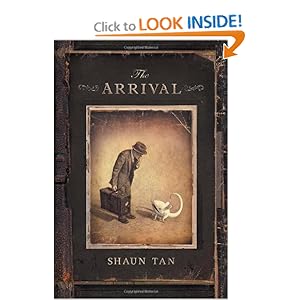
        Book Review - The Arrival by Shaun Tan


        Title: The Arrival
        Author: Shaun Tan  
        Year: 2007
        Page: 128  
        Genre: Graphic Novel

        New to me author? Yes  
        Read this author again? YES!
        Tearjerker? No
        Where did it take place? Earth...  
        FTC Disclosure: Borrowed from the library

        Summary (from amazon.com):  
        Tan captures the displacement and awe with which immigrants respond to their new surroundings in this wordless graphic novel. It depicts the journey of one man, threatened by dark shapes that cast shadows on his family's life, to a new country. The only writing is in an invented alphabet, which creates the sensation immigrants must feel when they encounter a strange new language and way of life. A wide variety of ethnicities is represented in Tan's hyper-realistic style, and the sense of warmth and caring for others, regardless of race, age, or background, is present on nearly every page. Young readers will be fascinated by the strange new world the artist creates, complete with floating elevators and unusual creatures, but may not realize the depth of meaning or understand what the man's journey symbolizes. More sophisticated readers, however, will grasp the sense of strangeness and find themselves participating in the man's experiences. They will linger over the details in the beautiful sepia pictures and will likely pick up the book to pore over it again and again.
         

        First Sentence:  
        n/a - it's wordless.

         
        Why did I pick this book?
        Read many GREAT reviews of this book. Wasn't sure if I was going to pick it up after trying some graphic novels earlier and didn't like them. But saw some other drawings done by this author and really liked it, so thought I'd give it a chance   

         
        My thoughts:
        • Wow. I LOVE his drawings - very detailed, amazingly realistic, and full of emotion. 
        • Calling this a graphic novel almost seems a bit insulting. His drawings are definitely a work of art. Something you can tear out from the book and frame it and hang it on the wall.
        • When they say a picture is worth a thousand words, you can definitely use this phrase to describe this book - and there are many pictures in this book, and without any words! I can't imagine the time and effort the author put into it (not to say that it doesn't take an author a lot of time and effort to WRITE a book... but typing something out seems easier than drawing something out!)
        • I could definitely relate to the story, having been a migrant TWICE. No where near the same experience as the story in the book, but the emotions you feel when leaving your family behind is the same nonetheless. 
        • 4.5 Stars instead of 5 - only because I haven't felt the need to buy this book for keep... (yet?) Told you it's hard for me to give out a 5!
          Rating:   4.5 Stars


          Have you read this book? 
          If you have, I would love to hear what you think! I'll link your review here if you wish!


          Challenges:
          100+ Reading