Pages


Showing posts with label books - Historical. Show all posts

Saturday, April 12, 2014

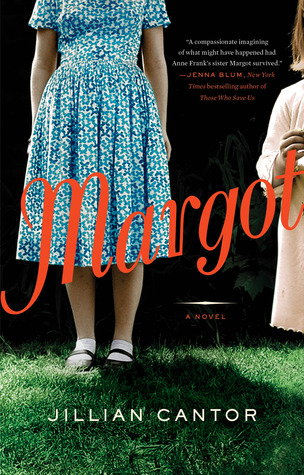
Margot by Jillian Cantor

Margot

Margot by Jillian Cantor

From Goodreads:

Anne Frank has long been a symbol of bravery and hope, but there were two sisters hidden in the annex, two young Jewish girls, one a cultural icon made famous by her published diary and the other, nearly forgotten.

In the spring of 1959, The Diary of Anne Frank has just come to the silver screen to great acclaim, and a young woman named Margie Franklin is working in Philadelphia as a secretary at a Jewish law firm. On the surface she lives a quiet life, but Margie has a secret: a life she once lived, a past and a religion she has denied, and a family and a country she left behind.

Margie Franklin is really Margot Frank, older sister of Anne, who did not die in Bergen-Belsen as reported, but who instead escaped the Nazis for America. But now, as her sister becomes a global icon, Margie’s carefully constructed American life begins to fall apart. A new relationship threatens to overtake the young love that sustained her during the war, and her past and present begin to collide. Margie is forced to come to terms with Margot, with the people she loved, and with a life swept up into the course of history.


Many of us probably have read The Diary of Anne Frank (I read the Chinese version when I was a kid). But what if her sister is still alive?

Interesting premise huh. It was just an okay read  - I think there is so much potential, but this read a bit more like a chicklit than what I was expecting.

Note - The book was borrowed from the library.


All reviews and posts are copyrighted by Christa @ Mental Foodie. Please do not use or reprint them without written permission.

Sunday, May 15, 2011

Book Review - Lost in Shangri-La: A True Story of Survival, Adventure, and the Most Incredible Rescue Mission of World War II by Mitchell Zuckoff


Title: Lost in Shangri-La: A True Story of Survival, Adventure, and the Most Incredible Rescue Mission of World War II
Author: Mitchell Zuckoffx 
Year: 2011
Page: 400
Genre: Non-Fiction - History

FTC Disclosure: Free ARC from HarperCollins in x

Summary (from goodreads.com):
On May 13, 1945, twenty-four American servicemen and WACs boarded a transport plane for a sightseeing trip over Shangri-La, a beautiful and mysterious valley deep within the jungle-covered mountains of Dutch New Guinea. Unlike the peaceful Tibetan monks of James Hilton's bestselling novel Lost Horizon, this Shangri-La was home to spear-carrying tribesmen, warriors rumored to be cannibals. But the pleasure tour became an unforgettable battle for survival when the plane crashed. 


Miraculously, three passengers pulled through. Margaret Hastings, barefoot and burned, had no choice but to wear her dead best friend's shoes. John McCollom, grieving the death of his twin brother also aboard the plane, masked his grief with stoicism. Kenneth Decker, too, was severely burned and suffered a gaping head wound.

Emotionally devastated, badly injured, and vulnerable to the hidden dangers of the jungle, the trio faced certain death unless they left the crash site. Caught between man-eating headhunters and enemy Japanese, the wounded passengers endured a harrowing hike down the mountainside--a journey into the unknown that would lead them straight into a primitive tribe of superstitious natives who had never before seen a white man or woman.

Drawn from interviews, declassified U.S. Army documents, personal photos and mementos, a survivor's diary, a rescuer's journal, and original film footage, Lost in Shangri-La recounts this incredible true-life adventure for the first time. Mitchell Zuckoff reveals how the determined trio--dehydrated, sick, and in pain--traversed the dense jungle to find help; how a brave band of paratroopers risked their own lives to save the survivors; and how a cowboy colonel attempted a previously untested rescue mission to get them out.

By trekking into the New Guinea jungle, visiting remote villages, and rediscovering the crash site, Zuckoff also captures the contemporary natives; remembrances of the long-ago day when strange creatures fell from the sky. A riveting work of narrative nonfiction that vividly brings to life an odyssey at times terrifying, enlightening, and comic, Lost in Shangri-La is a thrill ride from beginning to end.


First Sentence:
On a rainy day in May 1945, a Western Union messenger made his rounds through the quiet village of Owego, in upstate New York.

My Thoughts:

Why this book?
  • While history books aren't usually my genre, this one promised to read like a fast-paced adventure fiction. Besides, my husband would really enjoy this one since he loves reading about wars, so I thought this would be a good contender for our "read aloud" together (me reading it out loud to him as he prefers audio and I prefer prints)
First thought:
  • I am just glad I wasn't on that plane...
Cover Art:
  • I have an ARC so my cover was actually the second picture posted (the green one). I actually prefer this version over the one that got released (the more orange one) because of the jungle. I still think the cover could be a bit more attractive - maybe an actual picture of Shagnri-La / Baliem Valley and/or the natives?
Title:
  • Fitting, interesting and concise
Writing:
  • Easy to read, with a subtle sense of humor (when appropriate). 
Plot:
  • The author had conducted extensive research for this book and it showed - not just the event, but the different characters mentioned in the book too. Because of that, sometimes it got side-tracked a bit (e.g. by providing the background of a non-key-but-not-too-minor characters). We read this book together over a couple of months due to our schedule, and sometimes I had to think back about what happened or whom that person was.
  • The story was engaging though as we really wanted to find out what happened - did they beat the odds? If so, how? 
Characters:
  • We really got a sense of whom the main characters were - especially since we got read some of their diary entries. 
  • It was really interesting to read about the natives, and the perceptions and/or assumptions from both sides. I had always been fascinated by cultural differences so I really enjoyed reading this part. I am a little sadden about how they turned out as reported in the epilogue. 
  • There were quite a lot of people mentioned in the book - some played a bigger part than others. I guessed the author just wanted to acknowledge them, and documented their role in the story. I was particularly glad he played special tributes to the paratroopers, especially the medics  - they deserved the kudos.
  • It wasn't until we finished the book that I found a list of all characters at the end of the book! Would have been better if the list was placed in the beginning of the book so I knew it was there to start with! Typically I tried not to flip to the back of any books in case I read the ending by accident...
Ending:
  • I was pleased the author included an epilogue.
Emotion:
  • I couldn't imagine having to go through what the main 3 characters went through. There definitely were some touching moments, especially when it came to McCollom - he was so young and yet so mature
What I Learned:
  • I didn't know about Dutch New Guinea and its involvement in WWII. Definitely learned quite a few new things in this book!
PS:
  • The husband enjoyed this book as I predicted. I asked him how he'd rate out of 5 stars. He wouldn't give me an answer as he hates rating things (and I ask him to rate things a lot lol)
Read this Author again?
  • Yes!

Quote:
Margaret described a lesson she carried with her from the valley. "Fear is something I don't think you experience unless you have a choice. If you have a choice, then you're liable to be afraid. But without a choice, what is there to be afraid of?You just go along doing what has to be done." (p316)

Overall Rating:
4 Stars.


All reviews and posts are copyrighted by Christa @ Mental Foodie. Please do not use or reprint them without written permission.

Sunday, March 6, 2011

Book Review - People of the Book by Geraldine Brooks


Title: People of the Book
Author: Geraldine Brooks
Year: 2008
Page: 372
Genre: Fiction - Historical

FTC Disclosure: Borrowed from the library

Summary (from goodreads.com):
From the Pulitzer Prize-winning author of March, the journey of a rare illuminated prayer book through centuries of war, destruction, theft, loss, and love.

First Sentence:
I might as well say, right from the jump: it wasn't my usual kind of job.

My Thoughts:

Why this book?
  • My coworker recommended it, when another coworker and I were talking about books and she wanted some recommendations. I have heard of it before (positive) and thought it sounded intriguing - a bit of an adventure and solving puzzles. I have never read The DaVinci Code, but had watched the movie and like the genre. So thought this book might be similar.
First thought:
  • Argh. 
Cover Art:
  • Couldn't figure out what it was at first. Was it a butterfly? Was it a fish? Thought it could have been better.
Title:
  • The title definitely sounded interesting, especially appealing to a reader!
Writing:                          
  •   The beginning was engaging. But then it slowed and dragged on...
  • I found that I liked it better when the parts of the story were written first person. The parts written in third person... I ended up skimping parts of the book because those parts bored me. 

Plot:
  • The book alternated between past and present. The parts about the past had different setting and time frame. They were supposed to provide the background of the book throughout its history at different point in time. Because of that, those parts also read like short stories, which I don't like reading. Thus the book seemed disjoint.
Characters:
  • Felt indifferent about them... the part I liked best was probably the slang the main protagonist used - she was Australian, so every so often you saw Aussie slang like Woop Woop and Bloody. I lived in Australia for 13 years so I liked the familiarity (and made me miss my friends back home - though since I have lived in 3 countries, I am not quite sure where home is anymore).
Ending:
  • Okay... almost uneventful for me. 
Emotion:
  • Didn't feel much really... 
What I Learned:
  • The most interesting part was probably about book conservation. I wished the story devoted a bit more to it
PS:
  • I almost abandoned this book... but wanted to find out what happened so ended up skimping parts of it instead. Maybe if this was a movie I'd have liked it better.
Read this Author again?
  • Maybe not... March, about the father of "Little Women" sounded kinda interesting, but I don't know if I'd get bored or not...

Quote: 
N/A

Overall Rating:
2 Stars. Not for me. Historical fiction is 50-50 for me. I am usually glad to learn something from history, but since it's usually a genre I am interested in, it has to be done in a very entertaining way to capture my attention.


All reviews and posts are copyrighted by Christa @ Mental Foodie. Please do not use or reprint them without written permission.

Sunday, January 23, 2011

Book Review - The Emancipator's Wife: A Novel of Mary Todd Lincoln by Barbara Hambly


Title: The Emancipator's Wife: A Novel of Mary Todd Lincoln
Author: Barbara Hambly
Year: 2005
Page: 624
Genre: Fiction - Historical

FTC Disclosure: Borrowed from the library


Summary (from goodreads.com):
As a girl growing up in Kentucky, she lived a sheltered, privileged life filled with picnics and plantation balls. Vivacious, impulsive, and intoxicated by politics, she is a Todd of Lexington, an aristocratic family whose ancestors defeated the British. But no one knows her secret fears and anxieties. Although she is courted by the most eligible suitors in the land, including future senator Stephen Douglas, it is a gangly lawyer from Illinois who captures her heart. After a stormy courtship and a broken engagement, Abraham Lincoln will marry twenty-four-year-old Mary Todd and give her a ring inscribed with the words “Love Is Eternal.”

But their happiness won’t last nearly so long. Their first child will be born under the gathering clouds of a civil war, and three more follow. As Lincoln’s star rises, the pleasure-loving Mary learns, often the hard way, the rules of being a politician’s wife. But by the time the fiery storm of war passes, tragedy will have claimed two sons, scandal will shadow her days as First Lady, and an assassin’s bullet will take Lincoln himself, leaving Mary alone and all but forgotten by the nation that owed her husband its survival.

Yet it is in the years to come that Mary Todd Lincoln will truly come into her own. In public, she will fight to preserve Lincoln’s memory even as she battles a bitterly contested insanity trial. In private, she will struggle with depression and addiction as she endures the betrayals–both real and imagined–of family and friends.

With a gifted novelist’s imagination and a historian’s eye for detail, Barbara Hambly tells a story of astonishing scope, richly peopled with real-life characters and their fictional counterparts, a tour-de-force tale of power, politics, and the role of women in nineteenth- century America. The result is a Mary Todd Lincoln few have seen and none will forget–the fascinating, controversial woman of whom her husband could say: “My wife is as handsome as when she was a girl and I fell in love with her; and what is more, I have never fallen out”–Mary Todd, the woman who loved Abraham Lincoln.


First Sentence:
Encountering Mary Todd Lincoln was the nicest thing that happened to John Wilamet on his first day in the Promised Land.

My Thoughts:

Why this book?
  • Library book club February pick. Not something I'd normally choose for sure.
First thought:
  • I learned something new, but boy, was it a long book (600+ pages). Would be better if it was shorter!
Cover Art:
  • Not bad. Gave the impression that it is a historical novel. Fits the book. Just not very exciting...
Title:
  • It is not something that would have caught my attention...
Writing:
  • Pretty easy to read, but some passages were overly descriptive for my last. I think it could have been a bit shorter if it was edited tighter.
Plot:
  • It did made me want to find out what happened, however, the story went back and forth A LOT between Mary's childhood/teenage/younger years, and later years. It got rather confusing sometime. 
  • I wish it was written in a more linear fashion so I could read to find out what happened next, rather than "this happened now... let's go back x number of years... then 357 pages later we'd explained what happened in the first chapter, but before that we needed to go back 5 more years first"
  • Some parts also seemed repetitive, and I wasn't sure about some of the "dreams" Mary had... 
Characters:
  • I liked Mary when she was a young girl - she was independent and had her own ideas (though during the book club discussion, some thought she was manipulative and a chronic liar). I didn't like her after she married Lincoln. I felt bad for her though after he died
  • There were lots of other characters (Mary had lots of siblings and half siblings, and other rich friends and "beaus") and I wish the book included a family tree as it was difficult to remember everyone's names, and some had similar names!
  • While the story was supposedly quite true to historical records, one of the minor but important character, John, who was a freed slave, was fictional. While I think his own story may have been interesting, his side story made the story longer... 
  • Since I didn't grow up in the US, I didn't know a lot about Lincoln (and nothing about Mary Todd). The portrayal of Lincoln was negative at times which surprised me a little, but I suppose if you knew more about his history it shouldn't come as a surprise (e.g. I didn't know he came from "backward" country with no etiquette, was considered odd looking etc.)
  • Mary and Licoln's oldest son Robert also was not very likable... in fact many characters weren't very likable... but you have to agree that Mary Todd went through a lot and led a rather tragic life. Had she lived in modern society now, she probably would have lived a very different life
Ending:
  • A rather predictable or expected ending I guess... since this book pretty much covered Mary Todd's whole life, I guess it was acceptable.
Emotion:
  • I was glad I didn't live in that era! But I didn't feel overly emotional while reading it. 
What I Learned:
  • I learned quite a bit about Mary Todd, Lincoln, and what life was like back then. Since I am not a big history fan, this is the best way for me to learn more about the US history, so I am glad I read it, just wish it was a bit more concise.
PS:
  • All but one from the book club liked the book - the person who didn't like it thought it was a bit too long (I guess I liked it okay, but don't dislike it). For the first time since I'd joined last January, this was the first time we had spent the WHOLE HOUR discussing this book, and didn't get side tracked! Interestingly, a lot of people thought she was crazy, whereas I didn't think she was as crazy as I was led to think - she definitely had some mental issues (bi-polar, hoarding etc) but I don't know if crazy was the right word to describe her. 
Read this Author again?
  • I think it'd depend on the topic, and the length of the book :) I am not scared of big books, but sometimes I think less is more... (unless they are those books I wish I can never finish because they are so good that I want to keep reading about them forever!)

Quote:

I find myself looking forward to the end of my term as much as any of the poor slaves looked forward to Freedom (p53)

Could you marry a man who would stake his life - and your happiness - on a letter written in anger, that should simply have been put on the fire? (p90)

Overall Rating: 3 Stars - It's Okay. Glad I learned something, but could be better.


All reviews and posts are copyrighted by Christa @ Mental Foodie. Please do not use or reprint them without written permission.

Saturday, January 1, 2011

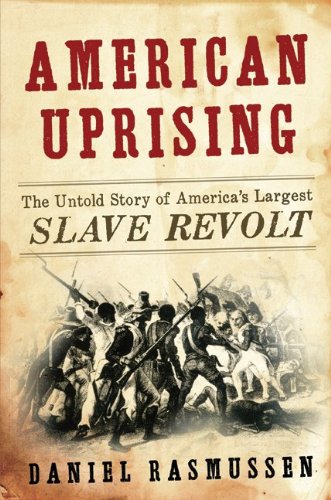
Book Review - American Uprising: The Untold Story of America's Largest Slave Revolt by Daniel Rasmussen


Title: American Uprising: The Untold Story of America's Largest Slave Revolt
Author: Daniel Rasmussen
Year: 2011
Page: 288
Genre: Non-Fiction - History

New to me author? Yes
Read this author again? Not sure
Tearjerker? No
Where did it take place? US
FTC Disclosure: Free ARC from HarperCollins

Summary (from goodreads.com):
A gripping and deeply revealing history of an infamous slave rebellion that nearly toppled New Orleans and changed the course of American history

In January 1811, five hundred slaves, dressed in military uniforms and armed with guns, cane knives, and axes, rose up from the plantations around New Orleans and set out to conquer the city. Ethnically diverse, politically astute, and highly organized, this self-made army challenged not only the economic system of plantation agriculture but also American expansion. Their march represented the largest act of armed resistance against slavery in the history of the United States.

American Uprising is the riveting and long-neglected story of this elaborate plot, the rebel army's dramatic march on the city, and its shocking conclusion. No North American slave uprising—not Gabriel Prosser's, not Denmark Vesey's, not Nat Turner's—has rivaled the scale of this rebellion either in terms of the number of the slaves involved or the number who were killed. More than one hundred slaves were slaughtered by federal troops and French planters, who then sought to write the event out of history and prevent the spread of the slaves' revolutionary philosophy. With the Haitian revolution a recent memory and the War of 1812 looming on the horizon, the revolt had epic consequences for America.

Through groundbreaking original research, Daniel Rasmussen offers a window into the young, expansionist country, illuminating the early history of New Orleans and providing new insight into the path to the Civil War and the slave revolutionaries who fought and died for justice and the hope of freedom.


First Sentence:
In 1811, a group of around 500 enslaved men dressed in military uniforms and armed with guns, cane knives, and axes rose up from the slave plantations around New Orleans and set out to conquer the city.

 
Why did I pick this book?
When HarperCollins asked if I wish to review some of their January 2011 titles, this one caught my eye as I wish to learn more about the history of slavery.


My thoughts:
  • After I read The Help, I wish to learn more about slavery and its history in the US. While I don't typically read history books, I thought this may be a good book to start as I remember reading a blurb about "it read like a fiction" 
  • I am afraid though I couldn't finish the book... I just couldn't get into it and got bored :( 
  • Since history usually is not my genre, I think I'd stick to historical fiction instead if I want to learn a little more about history (I know, fiction is not 100% accurate... but at least it may spark my interest into learning more...)
  • I think I'd pass this ARC onto someone else who may be more interested in this genre, rather than have it sitting on my shelve and go to waste. I think next time I'd be more careful in choosing ARC - to be fair to the author. Lessons learned. 
  • This book will be out on Jan 4, 2011.


      Overall Rating: 0 Stars. Did Not Finish.


      Have you read this book? 
      If you have, I would love to hear what you think! I'll link your review here if you wish!


      Sunday, October 24, 2010

      Book Review - The Piano Teacher: A Novel by Janice Y. K. Lee


      Title: The Piano Teacher: A Novel
      Author: Janice Y. K. Lee
      Year: 2009
      Page: 328
      Genre: Fiction - Historical

      New to me author? Yes
      Read this author again? No
      Tearjerker? No
      Where did it take place? Hong Kong
      FTC Disclosure: Borrowed from the library

      Summary (from goodreads.com):
      In the sweeping tradition of The English Patient, a gripping tale of love and betrayal set in war-torn Hong Kong. 


      First Sentence:
      It started as an accident.
        
      Why did I pick this book?
      It was part of book club read. Actually I suggested it as a pick, after reading numerous good reviews on different blogs. I was really interested in in as I lived in Hong Kong for 13 years, and played the piano, so I felt like I could relate to the book. This book eventually was voted to be part of this month's book club choice.


      My thoughts:
      • Meh. Why did I waste my time? I was so looking forward to it as I wanted to read another good historical fiction ("The Help" was a great read, and I usually don't like historical fiction). I thought the combination of a story setting in Hong Kong and something about the piano would make me like it a little bit at least!
      • Seriously, after I read it, I thought, what was the point of the story? What was the author trying to say? And I couldn't think of a good reason... to me, the author wanted to pack too much into a book, and because of that, everything was just left hanging and not gone into depth enough - it had a somewhat love triangle (I won't even call it a romance), a mystery of the Crown Collection, expats / high society living in Hong Kong, before / after the WWII, a twist about the identity of one of the minor characters, etc etc etc...
      • I don't even know why the title was chosen as that wasn't even a big part of the story
      • Some of the actions by the characters made you go huh? What did that add to the story (for those who had read it - it's about Claire and what happened in the first chapter - wasn't really explained)
      • The characters weren't likable either. 
      • Some chapters were quite choppy, and the writing style wasn't consistent throughout the book. I caught myself re-reading the lines several times to see if I really read what I thought I read. It was almost like the author wanted to reveal something big, but it ended up being pretentious and confusing. (I should've noted the page numbers, but forgot)
      • The love triangle wasn't that great - they happened too easily and I don't see how they could be so memorable
      • The mystery/twist also wasn't that shocking
      • I was hoping to read more about how WWII and its brutality. It touched on it a bit but not a whole lot.
      • I just felt like I wasted my time reading this - it has potential but everything was just left hanging instead. In fact, it probably would have been a better story if it was just about Trudy and Will, and leave the part about Claire. But then, since Claire was the piano teacher, the title would have to be changed! Not that it is a good title for the current story... 

         
        Rating: 1 Star


        Have you read this book? 
        If you have, I would love to hear what you think! I'll link your review here if you wish!


        Challenges:
        100+ Reading

        Sunday, May 30, 2010

        Book Review - Moloka'i by Alan Brennert


        Title: Moloka'i
        Author: Alan Brennert
        Year: 2004 
        Page: 400 
        Genre: Fiction - Historical

        New to me author? Yes 
        Read this author again? Probably not 
        Tearjerker? No 
        Where did it take place? US
        FTC Disclosure: Borrowed from the library

        Summary (from amazon.com):
        Compellingly original in its conceit, Brennert's sweeping debut novel tracks the grim struggle of a Hawaiian woman who contracts leprosy as a child in Honolulu during the 1890s and is deported to the island of Moloka'i, where she grows to adulthood at the quarantined settlement of Kalaupapa. Rachel Kalama is the plucky, seven-year-old heroine whose family is devastated when first her uncle Pono and then she develop leprous sores and are quarantined with the disease. While Rachel's symptoms remain mild during her youth, she watches others her age dying from the disease in near total isolation from family and friends. Rachel finds happiness when she meets Kenji Utagawa, a fellow leprosy victim whose illness brings shame on his Japanese family. After a tender courtship, Rachel and Kenji marry and have a daughter, but the birth of their healthy baby brings as much grief as joy, when they must give her up for adoption to prevent infection. The couple cope with the loss of their daughter and settle into a productive working life until Kenji tries to stop a quarantined U.S. soldier from beating up his girlfriend and is tragically killed in the subsequent fight. The poignant concluding chapters portray Rachel's final years after sulfa drugs are discovered as a cure, leaving her free to abandon Moloka'i and seek out her family and daughter. Brennert's compassion makes Rachel a memorable character, and his smooth storytelling vividly brings early 20th-century Hawaii to life. Leprosy may seem a macabre subject, but Brennert transforms the material into a touching, lovely account of a woman's journey as she rises above the limitations of a devastating illness.


        First Sentence:
        Later, when memory was all she had to sustain her, she would come to cherish it: Old Honolulu as it was then, as it would never be again.   

        Why did I pick this book?
        Heard about it from an online forum and quite a few people recommended it. As I tried to widen the genre I read, I decided to read this, plus I want to visit Hawaii!


        My thoughts:
        • I had such high hope for this book, and sadly it didn't quite live up to my expectations. I found the premise interesting - I don't know a whole lot about leprosy and the history of Molokai, so I definitely learned something. However, what potentially could have been a heart wrenching story (family separation, fear from those who were "clean", deteriorating health...), was a rather boring story to me... the pace was rather slow, and the writing was flat. More importantly, I don't feel emotionally attached to the characters. I don't dislike them, but I don't love them - when I read a good book, I couldn't wait to find out what happened to the characters; I'd be thinking about them when I couldn't read. But not this time... I didn't cry with them, I didn't laugh with them. I was more just an observer, rather than living their tales.
        • The book really was about Rachel's life, from when she was a young child up until her death - I suppose some would argue that 400 pages isn't too long for one's life story... but everything seemed to just tied up too neatly. 
        • I did find something I like - Keo - the name of one of the minor characters
        •  All in all, I felt like the book presented more fact, than stories; but not enough to call it a non-fiction book.

          Quote:

          "There's only one disadvantage, really, to having two mothers," Ruth admitted. "You know twice the love... but you grieve twice as much." (p382)

           
          Rating: 3 Stars


          Have you read this book? 
          If you have, I would love to hear what you think! I'll link your review here if you wish!


          Challenges:
          100+ Reading
          Global

          Friday, May 28, 2010

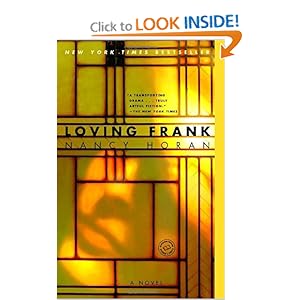
          Book Review - Loving Frank: A Novel by Nancy Horan


          Title: Loving Frank
          Author: Nancy Horan    
          Year: 2008  
          Page: 400  
          Genre: Fiction - Historical    

          New to me author? Yes    
          Read this author again? Not sure
          Tearjerker? No
          Where did it take place? Yes  
          FTC Disclosure: Library bookclub bag  

          Summary (from amazon.com):
          Horan's ambitious first novel is a fictionalization of the life of Mamah Borthwick Cheney, best known as the woman who wrecked Frank Lloyd Wright's first marriage. Despite the title, this is not a romance, but a portrayal of an independent, educated woman at odds with the restrictions of the early 20th century. Frank and Mamah, both married and with children, met when Mamah's husband, Edwin, commissioned Frank to design a house. Their affair became the stuff of headlines when they left their families to live and travel together, going first to Germany, where Mamah found rewarding work doing scholarly translations of Swedish feminist Ellen Key's books. Frank and Mamah eventually settled in Wisconsin, where they were hounded by a scandal-hungry press, with tragic repercussions. Horan puts considerable effort into recreating Frank's vibrant, overwhelming personality, but her primary interest is in Mamah, who pursued her intellectual interests and love for Frank at great personal cost. As is often the case when a life story is novelized, historical fact inconveniently intrudes: Mamah's life is cut short in the most unexpected and violent of ways, leaving the narrative to crawl toward a startlingly quiet conclusion. Nevertheless, this spirited novel brings Mamah the attention she deserves as an intellectual and feminist.

          First Sentence:  
          It was Edwin who wanted to build a new house.

          Why did I pick this book?    

          April book club pick. While it is not a book I'd have picked on my own, I was looking forward to it as I love Frank Lloyd Wright's architecture (not that I know a lot about it, but just remember I like what I saw in pictures.)


          My thoughts:
          • It is hard for me to rate this book, so in the end I just gave it a 2.5 stars /  just okay / meh to me
          • Before I forget, the main female lead (FLW's mistress)'s name is Mamah - pronounced May-mah. I kept thinking it's ma-ma.
          • The reason I was conflicted on how to rate this book - on one hand, I like that the author took little pieces of history (that wasn't a lot about Mamah) and created a plausible story out of it, and I totally didn't see the ending coming (a historically true event, but I just didn't know about it - so if you plan to read this book, don't read about FLW on wikipedia!). The writing is a little slow though and I think the book could have been shorter (probably didn't help that the font was VERY SMALL - I wear glasses and in my early 30's but man, why couldn't they use a bigger font so people would at least won't be put off by it! That seriously was my first reaction when I opened the book). Anyway, on the other hand, I did NOT like the main characters, namely FLW and Mamah, AT ALL. While I am still amazed by FLW's artistic vision, I wouldn't want to live with him - he thought silverware was cluttered on a set table at meal time, until he was ready to use them! As for Mamah, there were decisions she made regarding her children that I just do not agree, and I don't even have children. Some may think she was a pioneer feminist, but I thought she was just selfish and self-centered. At the book club discussion, some mentioned that they made a good pair and deserved each other!
          • So it wasn't quite the epic love story I was hoping to be... not that I think a story on adultery should have been about this great love, but at least it would have made it easier to understand why she did what she did...   
          • I like the "conversation with Nancy Horan" section at the end - to learn why she decided to write the book. And I did learn a little more about FLW from this book
          •  After reading it, I want to tour his houses!!! There are 3 of them in my town, though they are not vacant I don't think... supposedly you can see 2 of them just from driving past, but I want to see the inside! May have to pay a visit to Taliesin house in Spring Green WI (the place where the book ended.) There are some other houses of his that can be rented out too for the night - might be something fun to do in the future!
          Quote:

          "Tell her happiness is just practice," he (Edwin) said. "If only she acted happy, she would be happy." (p5)

          "The measure of a man's culture is the measure of his appreciation," he (Frank) said. "We are ourselves what we appreciate and no more."

          He (Frank) gestured out toward the horizon, where a clear sky bordered prairie grasses as far as the eye could see. "Eventually, I fell under the spell of the line out there. It was so simple: a huge block of blue on top of a block of gold prairie, and the quiet line between heaven and earth stretching endlessly. It felt like freedom itself to look at the horizon. I had been drunk on forms since I was a boy, and here was this simple line that expressed so much about this land." (p21)

          To fare on -- fusing the self that wakes... and the self that dreams. (p88)


            Rating:   2.5 Stars


            Have you read this book? 
            If you have, I would love to hear what you think! I'll link your review here if you wish!
            Challenges:
            100+ Reading