Pages


Sunday, January 31, 2010

Book Review - Notes Left Behind by Brooke and Keith Desserich


Title: Notes Left Behind
Author: Brooke and Keith Desserich
Year: 2009
Page: 272
Genre: Non-fiction - Memoir

New to me author? Yes
Read this author again? Maybe
Tearjerker? Yes (especially towards the end of the book)
Where did it take place? US
FTC Disclosure: Borrowed from the library

Summary (from amazon.com):
A Cincinnati couple bravely and lovingly recorded the last months of their six-year-old daughter's life after she was handed the devastating prognosis of terminal brain cancer. A trip to the doctor's office to treat Elena's strep throat resulted in an MRI that revealed a large tumor lodged within the walls of Elena's brain stem—in the worst place with one of the worst tumors out there. The kindergartener, who also had a younger sister, Grace, was given three to six months to live. A miracle was what the family hoped for, traveling to Memphis for six weeks of an experimental treatment involving intensive radiation, chemotherapy and tests; already Elena's speech, mobility and ability to eat had been affected, symptoms of the tumor's progression that would recede and recur over the next several months. The parents kept this diary from November 29, the beginning of their daughter's treatment, until her death August 11, Day 256, written in alternating POVs (mostly Keith's; Brooke's is rendered in italics), even recording some of Elena's own musings, such as that all she wanted was to be normal. The parents remained resolute in her treatment, even upbeat despite the anger Keith felt at the unfairness of this disease. Instead of planning their daughter's future, the Desseriches sadly found themselves counting [her] days. This heartbreakingly forthright journal helped the authors push back that second-worst day—when the memory of their daughter would be forgotten.

First Sentence:
It began early.

Why did I pick this book?
Saw it on the library's new book list, read the reviews on amazon which were almost all 4 and 5 stars.

My thoughts:
  • I thought originally (from the title) that the book was a journal of 6 year old Elena, but it was actually her parents' (mostly dad's) journal instaed (I think it may have been a blog). The parents wanted to write it so their younger daughter Gracie won't forget about Elena

  • It is very difficult to rate this book - I mean, this is definitely a very, very sad story and yes, I cried my eyes out especially towards the end of the book (I found the August 4 entry about the dance was the most heart-wrenching), but at the same time, it is a story I'd had read of before - articles about other similarly brave kids who courageously fought their terrible diseases - so the lessons learned, "treasure your time with your kids", "spend time with your family" etc isn't really new, but still a good reminder

  • The beginning of the book was a bit flat (I'd have been more scared and lost!), and sometimes the content got a bit repetitive - but I suppose, since this was a journal/blog, it was understandable that some of their feelings/thoughts kept recurring. It was probably not something that noticeable if you just read an entry a day (i.e. if you follow their blog), but I pretty much read the book in 2 settings (before I slept, and after I woke up the next day) so the repetitiveness was more pronounced. I also have to remember that the parents aren't professional writers, but you do get to see their honesty

  • I think what got to me more was the pictures rather than the text that they included in the book. Elena was an adorable girl but you could see how the medication/steroid and cancer took a toll on her and it was very devastating to see. The photos were black and white only, and not the best quality since they were a bit grainy, but I suppose it would have been expansive to include color glossy pictures in books. Though I appreciate that they had the pictures through out the books, rather than having them all in the centerfold as most books do - so you really do see the progression as you read the text

  • While this was not the most inspirational book I'd read (to me), I was still glad I read it. Most importantly though, I hope the younger daughter, Gracie, would read it one day and understood the important role she had played in her sister's life, and why her parents had to neglect her a little sometimes to take care of Elena. Since I have 2 younger sisters, I think the sisterly-love described in the book was quite touching, especially when they were both so young

Quote:


I learned more about my daughter in eighteen days than I'd learned about her in five years, eleven months and twenty-six days. (p34)

For despair forces you to live in the present while your mind races to the future. (p95)

"Never look at a day and think it is a bad day, because this may be better than tomorrow, so just thank God that you have the day at all." (p177)


Since we're all book lovers here, and so was Elena, I thought it was interesting to read about story time with her parents before bed:


To read a book with Elena is a methodical journey. First, you must do away with the book jacket if it has one. After all, in order to experience the majesty that is bedtime reading you must not only view the pages but feel the cover as well. But be careful to place the jacket back on the shelf -- you will need to re-cover it as soon as you finish the book. Next, always remember to mention the author's name, present the cover to the audience and then prompt them to tell you what they think the book is about. never mind that the audience may only be Mom, Gracie and me. Third, open the book tot he first page and review the copyright and the illustrator if different than the author. Now, we must pause at the copyright and discuss Elena's age at the point of original publication. Finally, you are ready to read, but make sure to discuss the quality of the illustrations and how the author conveys movement with the pictures. Faraway pictures that become close-ups indicate that the subject is traveling. It is also important to understand the illustrator's use of color. Bright colors convey happy feelings, while dark colors convey sadness. Once you have made your way through the book, close it, set it on your lap and ask the audience to "Discuss the book" with you. Then and only then have you truly enjoyed your bedtime reading. Now you know why it also takes us an hour or more to read three children's books every night. (p100-101)


Rating:


You may also like these books I'd read:


The Last Lecture by Randy Pausch & Jeffrey Zaslow


Josie's Story: A Mother's Inspiring Crusade to Make Medical Care Safe by Sorrel King


Have you read this book? 
If you have, I would love to hear what you think!
I'll link your review here if you wish!


Challenges:
100+ Reading
Memorable Memoir

Friday, January 29, 2010

Book Review - Genetic Rounds: A Doctor's Encounters in the Field that Revolutionized Medicine by Robert Marion MD


Title: Genetic Rounds: A Doctor's Encounters in the Field that Revolutionized Medicine 
Author: Robert Marion MD
Year: 2009
Page: 304
Genre: Non-fiction - medical, memoir

New to me author? Yes
Read this author again? Yes
Tearjerker? A little misty eyes with some stories
Where did it take place? US
FTC Disclosure: Borrowed from the library

Summary (from amazon.com):
Although he's often uncomfortable about it, as a clinical geneticist, Marion (The Intern Blues) examines his patients' genetic secrets—information they sometimes don't reveal even to close relatives—in order to help them make family planning decisions . His ability to solve medical mysteries can be a blessing: after a mother is accused of child abuse, Marion is able to use genetic analysis to diagnose brittle bone disease in the baby and to help return the infant to her mother. But his diagnostic skills become a curse when he tells his former college roommate that his toddler isn't just a slow starter but likely has Bardet-Biedl syndrome: the enraged friend never speaks to Marion again. In a headline-making case, he tries to explain why a pair of twins joined at the head lack speech. Although his short pieces lack the depth and finesse of essays by other physician-writers like Oliver Sachs, and Marion's case studies would frighten even the steeliest of would-be parents, Marion, director of clinical genetics at Montefiore Medical Center and Blythedale Children's Hospital in New York State, is a sympathetic advocate for his patients who lucidly interprets complex medical conditions for lay readers.

First Sentence:
One role of medical geneticists is to serve as patient advocates.

Why did I pick this book?
Saw it on the library's new book list online. Decided to reserve it because I am interested in medical related books (as long as it's not too scientific or written with a lot of technical terms/jargon). I had wanted to major in genetics when I was in college (bio-chemistry hated me) so I was particularly interested in a book about medical genetics.

My thoughts:
  • I really enjoyed this book - it was a fast read and he'd explain the medical terms/conditions in layperson terms so it was easy to understand

  • Each chapter was about a patient's stories (mostly pediatric patients) and some were quite touching. There were usually some ethical dilemma involved as well which really made you think what you'd do if you were in the doctor's position? Or if you were the parents? Or if you were the patient?

  • I guess since I like forensic science (TV shows like CSI, Bones, etc), I enjoyed that this field was trying to solve a puzzle (see quote below for a description of geneticist). Before reading this book, I have some idea what geneticists do, but this book really opened my eye about the role they play in medicine

  • Some stories could have been told better if  he didn't give away the ending first before explaining what actually happened, as it took the suspense away - but I suppose he wasn't writing a thriller/suspense novel...

  • I couldn't quite decide if I wanted to give this a 4 or 4.5 stars (4.25 would've been perfect!) - since I'm quite harsh with my rating (5 stars are hard to come by!) I think I'll leave it as a 4 stars for now. If I were going into this career field, I'd give it a 4.5 as I'd probably keep it as a reference book

  • A note of caution though - if you are pregnant or have young kids, you may not enjoy the book as much as I did (we don't have any kids) - you know, it's like you think you have all the symptoms when you read about different diseases online or watch some medical shows? There is no "graphic" description in the book but sometimes reality is more terrifying... it's definitely educational. Just thought I'd mention it - because I know sometimes when I read books (fictional or non-fiction), they effect me differently than those who have kids, since I can't quite put myself into the parents' position so those books don't affect me as much

Quote:

What do clinical geneticists do?

Often called on to solve mysteries, we play the role of medical detective, noticing subtle symptoms and signs and assembling them into a cohesive diagnosis. One of the heroes of modern clinical geneticists is Sherlock Holmes, Sir Arthur Conan Doyle's amazing detective. It was in Doyle's story "A Case of Identity" that Holmes says, "It is my business to know things. Perhaps I have taught myself to see what others overlook." THis is exactly the mantra of the clinical geneticist. (p27)


    Insights into doctor/patient relationship:

    "In practicing medicine (and clinical genetics in particular), providing for the emotional needs of the family both at the time of the initial encounter and then on an ongoing basis, can be as important (if not more important) than the provision of physical care. This may be the biggest epiphany I've experienced during the years I've been in practice." (p70)

    "It's as if I really have two patients: the child with the disease and his or her family. My role in looking after the child is usually fairly straight-forward; my role with the other patient, however is less so." (p137)


    A 4 year old patient's story:

    "She (4 year old daughter) handed it (her milk bottle) to me and said, "Here, Mommy. For you." "What's this for?' I asked her. "You crying, Mommy,' she replied, and in her own way, using a few words she had, she let me know that when she'd been little and cried, I always gave her a bottle of milk and that made her feel better. Because I was crying, she figured that giving me a bottle would make me feel better." (p146)


    Rating: 4 Stars


    You may also like these books I had read:


    Have you read this book? 
    If you have, I would love to hear what you think!
    I'll link your review here if you wish!


    Challenges:
    100+ Reading
    Memorable Memoir
    Science Books 

    Monday, January 25, 2010

    My 2010 Book List - Now Rank In Order!

    Sam from Book Chase has a great idea on organizing his Best of 2010 List - read his post here.

    So I have reorganized my Books Read in 2010 post - now it's ranked by how much I liked the book, rather than in chronological order. At the end of 2010, I could easily see what my top 10 books are for both fiction and non-fiction!

    Gotta love being efficient :)

    Sunday, January 24, 2010

    Cool Bookmarks!

    This is a blog I followed that I love - Inspire Me Now - and saw some really cool bookmarks!

    The following is posted originally from Icoeye - aren't they creative! Love Sherlock Holmes, Robin Hood, The Little Prince and Alice in Wonderland!


    Even with a bookmark, I always forget exactly where I stopped if it's not at a natural break like a new chapter. Would this be very useful!


    What do you usually use as bookmarks? I am still old-fashioned and read books, and don't own a kindle or other e-reader... guess that won't be a problem then. I usually just use some scrap paper - preferably thicker paper like card stock as they hold up better, and with space that I can write down notes or page numbers of the quotes or interesting insights I want to use in the review. How about you?

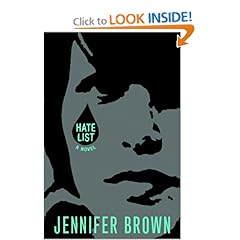
    Book Review - The Hate List: A Novel by Jennifer Brown


    Title:
    The Hate List: A Novel
    Author: Jennifer Brown
    Year: 2009
    Page: 416
    Genre: Fiction - Young Adult

    New to me author? Yes
    Read this author again? Yes
    Tearjerker? A littlel misty eye near the end
    Where did it take place? US
    FTC Disclosure: Borrowed from the library

    Summary (from amazon.com):
    Five months ago, Valerie Leftman's boyfriend, Nick, opened fire on their school cafeteria. Shot trying to stop him, Valerie inadvertently saved the life of a classmate, but was implicated in the shootings because of the list she helped create. A list of people and things she and Nick hated. The list he used to pick his targets. Now, after a summer of seclusion, Val is forced to confront her guilt as she returns to school to complete her senior year. Haunted by the memory of the boyfriend she still loves and navigating rocky relationships with her family, former friends and the girl whose life she saved, Val must come to grips with the tragedy that took place and her role in it, in order to make amends and move on with her life.

    First Sentence:
    The scene in the Garvin High School cafeteria, known as the Commons, is being described as "grim" by investigators who are working to identify the victims of a shooting spree that erupted Friday morning.

    Why did I pick this book?
    Read a few good reviews from other bloggers. Since I am doing a YA Challenge, need to read at least 12 this year! I read the non-fiction book about school shooting (for adults) last yer, Columbine by David Cullen, and liked it, so I thought it'd be interesting to read about the topic from a YA novel perspective.

    My thoughts:
    • Even though it is over 400 pages, it is a fast read. Jennifer Brown's writing style is straight forward which I appreciate

    • Since I'd read Columbine by David Cullen, which talked about the Columbine High School shooting, it was easy to imagine that this YA novel was real. I suppose since we don't have any kids, this book may not have as much impact on me as it would on others who have children

    • While the plot seemed realistic, I think there were a lot of characters that didn't quite get the attention or that they should be further developed - Bea, Jeremy, Duce, Stacy... characters that you think would play a much bigger role but didn't, thus become more of a distraction (I won't go into details who these characters were, so I won't give out any spoilers)

    • I don't really know if I get a full sense of who Valerie really was (perhaps, like a lot of teenagers, she doesn't really know herself either); and I don't know if it's the author's intention, but I actually ended up liking Nick's character (minus the shooting of cousre)? You couldn't help but feel sorry for him, but I think there is something missing between the sad Nick and the angry Nick

    • I gave this book 3.5 stars for my own personal "enjoyment" (if you could call it that) but it is probably a good book for teenagers, and their parents to read - perhaps together and discuss. The book did touch on a bit on the parents' roles - trust, and how parents affect the children when they don't even know it. Coincidentally, I saw a touching post titled "Be The Change" over at The Betty and Boos Chronicles about school bullying and what her second cousin Joey decided to do about it - he's only 15, and it's heart-wrenching what kids go through. Go to her blog about it please!

    • A couple of quotes from the book, conversations between Nick and Val:


      He turned to face me, propping himself up on an elbow. "It's good that we have each other," he said. "It's like, you know, even if the whole world hates you, you still have someone to rely on. Just the two of you against the whole world. Just us." (p50)

      He leaned over me, close to my face. "It's okay for someone to let you win sometimes, you know, " he said, getting all serious. "We don't always have to be the losers, Valerie. They may want to make us feel that way, but we're not. Sometimes we get to win, too." (p91)


    Rating:


    You may also like these books:


    Columbine by David Cullen (Non-fiction for adults)


    Have you read this book? 
    If you have, I would love to hear what you think!
    I'll link your review here if you wish!


    Challenges:
    100+ Reading
    Young Adult

    Book Review - Stargirl by Jerry Spinelli


    Title:
    Stargirl
    Author: Jerry Spinelli
    Year: 2004
    Page: 208
    Genre: Fiction - Young Adult

    New to me author? Yes
    Read this author again? Maybe
    Tearjerker? No
    Where did it take place? US
    FTC Disclosure: Borrowed from the library

    Summary (from amazon.com):
    Part fairy godmother, part outcast, part dream-come-true, the star of Spinelli's novel shares many of the mythical qualities as the protagonist of his Maniac Magee. Spinelli poses searching questions about loyalty to one's friends and oneself and leaves readers to form their own answers, said PW in our Best Books citation. Ages 12-up.

    First Sentence:
    When I was little, my uncle Pete had a necktie with a porcupine painted on it.

    Why did I pick this book?
    I saw some other blogger mentioned it, the premise sounds intriguing. Plus I love its simplistic cover and its colors (the cover I have has a blue background, with a yellow star and green matchstick girl with a triangle skirt).


    My thoughts:
    • I actually don't quite know how I feel about this book. I like the concept of it (accept others who are different, be proud of your own individuality, conformity / being like everybody else isn't always the best), but somehow the story fell a bit short, like something is missing, and I couldn't quite explain why.

    • I think perhaps Stargirl is a bit too unrealistic? That she is too naive? I am not sure if I like the protagonist, Leo, that much either. I suppose since now I'm an adult, "whose opinions do you value more" and popularity isn't as big of a deal as it was during teenage years

    • I do like the character Archie - it'd be cool to have someone like that around

    • I found out there is a sequel, Love, Stargirl, not sure if I'll read it. I don't hate this book but don't love it either. There are a few quotes I like that described Stargirl:


      "On the contrary, she is one of us. Most decidedly. She is us more than we are us. She is, I think, who we we really are. Or were." (p32)

      "An act? No. If anybody is acting, it's us." (p33)

      "You'll know her more by your questions than by her answers." (p35)

      Throughout the day Stargirl had been dropping money. She was the Johnny Appleseed of loose change: a penny here, a nickel there. Tossed to the sidewalk, laid on a shelf or bench. Even quarters.
      "I hate change," she said. "It's so... jangly."
      "Do you realize how much you must throw away in a year?" I said.
      "Did you ever see a little kid's face when he spots a penny on a sidewalk?" she said. (p117-118)

      I pointed to it (a tiny wagon about the size of a fist.) "You collecting stones, or what?"
      "It's my happy wagon," she said. "Actually, it could just as well be called an unhappy wagon, but I prefer happy."
      "So what's it all about?"
      "It's about how I feel. When something makes me happy, I put a pebble in the wagon. If I'm unhappy, I take a pebble out. There are twenty pebbles in all."(p121)


    Rating:


    Have you read this book? 
    If you have, I would love to hear what you think!
    I'll link your review here if you wish!


    Challenges:
    100+ Reading
    Young Adult

    Thursday, January 21, 2010

    Book Review - The Hunger: A Story of Food, Desire, and Ambition by John DeLucie


    Title:
    The Hunger: A Story of Food, Desire, and Ambition
    Author: John DeLucie
    Year: 2009
    Page: 256
    Genre: Non Fiction - Memoir, food

    New to me author? Yes
    Read this author again? No
    Tearjerker? No
    Where did it take place? NY
    FTC Disclosure: Borrowed from the library

    Summary(from amazon.com):
    With a cooking class and a Dean & Deluca's prep gig under his belt, DeLucie left behind a comfortable finance career for the cutthroat culinary industry of 1990s New York City. Eventually, he'd become a celebrity chef with his own destination restaurant co-owned by Vanity Fair editor Graydon Carter. Beyond talent and drive, DeLucie had the requisite outsized ego to make it in the NYC culinary scene, persevering despite the staggering number of failures (some almost immediately, and sometimes on the word of a single reviewer) he helps open. Readers may find DeLucie's self-important prologue hard to stomach, but if they're willing to humor him they'll find a genuinely good story as well as a survey of celebrity eating habits, drawn from his popular Greenwich Village restaurant The Waverly Inn (after his visit, Karl Lagerfeld sent out for "just our roasted carrots...every day for a week"). When he puts aside his ego, DeLucie provides an excellent balance of personal details and authentic backstage culinary tales. For all the name-dropping, DeLucie's is a satisfying triumph of hard work and sticktoitness.

    First Sentence:
    It's another magical night at The Waverly Inn.

    Why did I pick this book?
    I love reading food memoir, so when I saw this on our library's new book list, I decided to borrow it - especially since he didn't start his "chef life" until 30 - never too late to have a career change!

    My thoughts:
    • Disappointed. The whole book was pretty much about "I worked at this restaurant, then that restaurant, then this other restaurant, then..." and all the famous people and gorgeous girls he met. I thought it would be more inspirational, especially since he used to work as a recruiter, and then decided at age 30 to do something different

    • The chapters jumped between what restaurants he used to work at, and the "final"/latest restaurant he part-owned (The Waverly Inn). Since I don't live in NY, I haven't heard of this restaurant before, but I guess it's exclusive, and lots of celebrities go there or something. So sometimes it is a bit confusing going back and forth. I tried to see if there was a reason he decided to write it this way - perhaps to contrast the old and the new, or what mistakes he made back in the days and then applied the lessons learned nowadays. Well if that was the case, then it wasn't very clear

    • The part I liked the most was what the hotel/restaurant did on the day of 9/11 and shortly after, that was about the only part I felt the story wasn't flat

    • The crispy pan-roast chicken he cooked did sound delicious though (p155):
    • 3.5 lb chicken, butcher it, leaving the wing and thigh bones intact
    • Preheat a saute pan on high heat and add canola oil, just a scant amount, enough to coat the pan
    • When the oil starts to smoke, pat the chicken dry with a paper towel, then season with salt and pepper
    • Place it in the pan, skin side down
    • Next, take a brick, wrap it in foil, and place it on the chicken, allowing no air space between the skin and the surface of the blazing pan
    • Hoist the whole heavy mess and throw in the oven on as high a temperature as it will go
    • Blast it for 12 minutes or so until it is cooked
    • I did like his description between cooking and baking (p165):


      Baking is an exacting scientific endeavor. No "a pinch of this and a splash of that." Baking is classical music compared to savory cooking's jazz.


    • While I was reading this book, it very much reminded me of another book I read late last year - Dirty Dishes: A Restaurateur's Story of Passion, Pain, and Pasta by Pino Luongo and Andrew Friedman - both of them were of Italian heritage, both started from the bottom and worked hard to own their successful restaurants, both were from NY, both worked at the Hamptons during summer seasons... but the similarity ended there book-wise. I enjoyed Dirty Dishes a lot more (4 stars) as it really is inspirational and you can see Pino's visions. Now, I haven't eaten any of their restaurants, so I don't know how their food compared, this is purely comparing their books. Interesting, author John DeLucie mentioned Pino in his book on p181, "The partners also poached a fabulous pastry chef, Patty Jackson, who had cut her teeth with the legendary restaurateur and entrepreneur Pino Luongo, whose restaurants Le Madri, Coco Pazzo, and Tuscan Square are responsible in large part of bringing a Tuscan sensibility to New York City."

    • If you want to read food memoir, there are others I'd recommend (see below.) This is just an okay read... I almost abandoned it, but didn't, hoping it'd get better. Well, at least I was glad I read the part about 9/11 (p191-194).

    Rating:


    Have you read this book? 
    If you have, I would love to hear what you think!
    I'll link your review here if you wish!


    Other food memoir I like:


    Dirty Dishes: A Restaurateur's Story of Passion, Pain, and Pasta by Pino Luongo and Andrew Friedman


    Out of the Frying Pan: A Chef's Memoir of Hot Kitchens, Single Motherhood, and the Family Meal by Gillian Clark


    Kitchen Confidential: Adventures in the Culinary Underbelly by Anthony Bourdain


    Challenges:
    100+ Reading
    Memorable Memoir